Showing posts with label Cattle crush. Show all posts

Restraining animals: Devices - 2

 Restraining Animals: Devices - 1 can be found here.
Gags: A gag is a means for keeping the jaws apart for for probang use or examination of the mouth or teeth of horses, cattle, and buffaloes.
Several types of gags are in use, most are made of metal. The one in common use with large animals is called Varnell's movable gag. The bars of the gag or mouth piece fit into the interdental space. The tongue must always be free. The bars should be covered with rubber or leather to prevent damage to gums. Gags are also available for use with small animals such as sheep and goats. 
Bull Rings (Courtesy: shanahi.com)
Bull Rings: These are used for restraining powerful bulls. They are generally made of two semicircular pieces hinged together. They may be made of copper, aluminum, or some other alloy which does not rust.
There are large and small rings which are used according to the age and size of the animal. The ring is applied through the nasal septum about one cm back from the nostrils. A hole is first punched with a special bull puncher. When punching the hole, care should be taken not to punch it too far back. This is a common mistake. It results in too little space being available in that part of the ring lying outside the nostrils to accommodate a rope or a chain. Bulls are generally rung at the age of 10 to 14 months. Some bulls may need a new ring every year depending on the amount of wear and tear.
Muzzle (courtesy: sporthorse)
Muzzles: Three kinds of muzzles are in common use, namely leather, wire and string muzzles.
Leather Box Muzzle: This is the best type of muzzle, but it is expensive.
Wire Muzzle: This is less comfortable for the animal, but it is durable and inexpensive.
String Muzzle: This is a practical and inexpensive muzzle that can be made at home.
Muzzles are used to prevent animal
s from eating their bedding, to prevent biters from injuring people or other animals, and to prevent mares, etc. from biting their young ones. Calves are muzzled to prevent them from suckling their mothers. The muzzles should not be put on too tightly, otherwise the animal will resent its reapplication. Muzzles are taken off at feeding time.
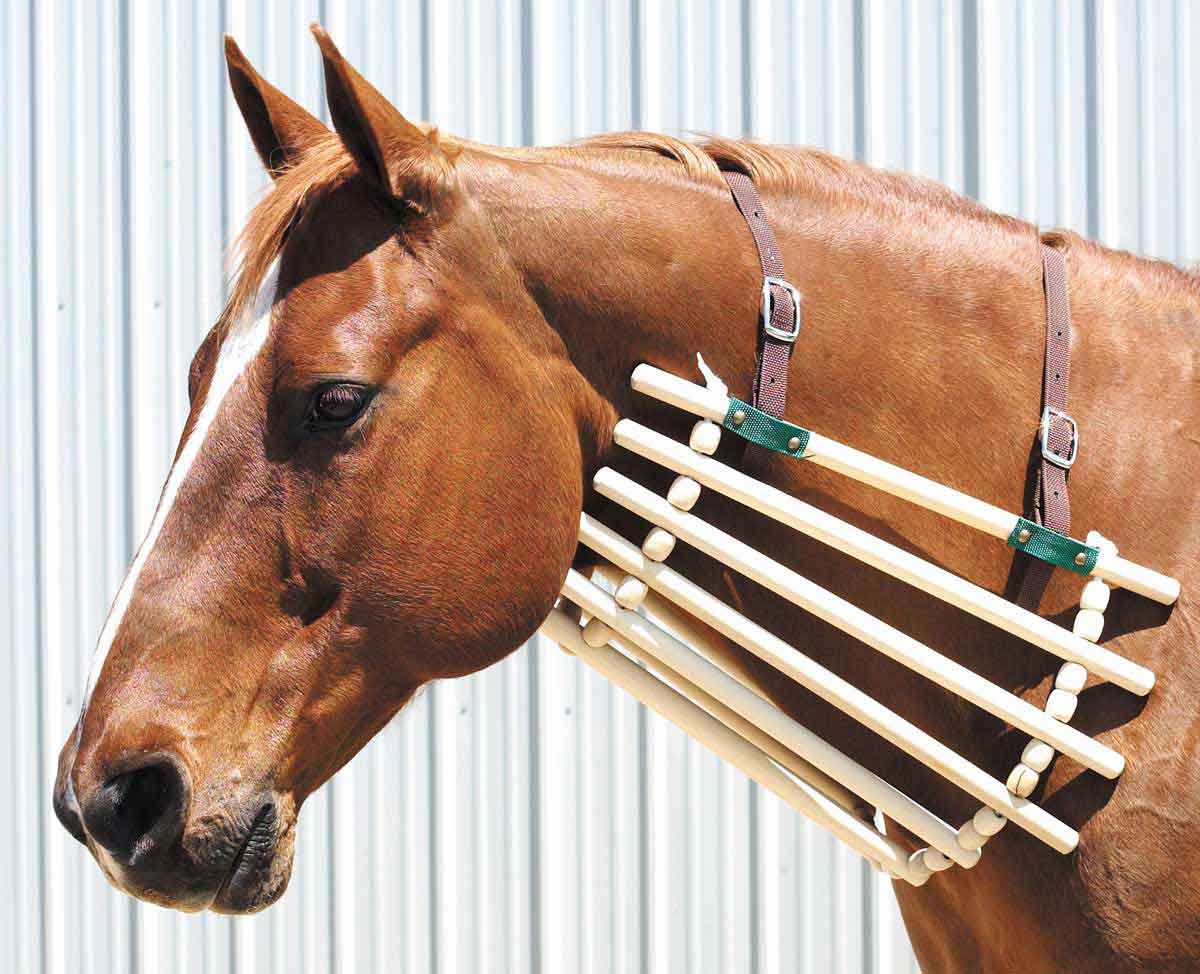
Cradle (courtesy: valleyvet.com)
Cradles: A cradle is a device consisting of 10 or 12 pieces of wood strung on two pieces of rope. A short piece of wood bored longitudinally is fitted in between long pieces. The long pieces are bored longitudinally at either end and a rope is strung through all of the pieces. Then it is put around the neck of the animal and tied along the crest. It is helpful when the animal must be prevented from getting its head to an injured or bandaged fore or hind limb or when medicine is applied to the body. It is also helpful in restraining a milking female when she wants to suck her own mild. Cradles allow very little vertical or lateral flexion of the head if properly applied.
Cattle Crush (courtesy: cashels.net)
Crushes: A crush (trevis) is a long, narrow alleyway for restraining animals in which animal's head is held in poles and the whole animal is firmly confined. It is especially useful for controlling large animals for operations such as dehorning, docking, and shoeing. Different types of crushes are used. These usually consist of four posts driven well into the ground and cemented there with two or more cross pieces at each side and end. Those at the end and/or the front are removable.
Ropes: Ropes are essential for restraining farm animals. Cotton rope is preferable because it is strong, safe and easy to use when making knots. Rough, hard ropes like coir should not be used since it can cause abrasions to the animals. Two sets of rope should always be kept ready: 
i. one about 2.5 - 3. cm thick and about 8 m long for sue in casting or securing large animals, and
ii. Two or three pieces, 1 - 1.5 cm thick and about 2 m long for securing small animals and the feet or horns of large animals. One or two lassos and rope halters should also be kept ready for any emergencies.

Restraining animals: Devices - 1

Halters: Halters are one of the simplest controlling devices for horses, cattle and buffalo. To make a halter, lay about 3 m of rope on the floor. At about 1 , from the left hand end, untwist the strands sufficiently to enable the right hand end to be passed through it to make a loop of about 2.5 cm in diameter. Lay the rope down as before. Close to the loop, untwist some strands again on the right hand side, and pass the left end through it. Pull up tight and bind the splice thus made with a few turns of string. To form a poll-piece, untwist the strands of the right hand length, about 25 cm from the loof already made, and pass the left hand end through it.
Make an overhand knot to fix. Bind on either side with string. Now pass the long right hand end through the spliced loop first made. This forms the nose-band. The halter is now complete. The knot in the poll-piece can be adjusted to fit the head of different animals.
To halter a horse, first slip the rope or shank of the halter around its neck by holding the forelock or resting the right hand on the neck just behind the ears. Then slip it over the horse's ears. The halter should be prevented from becoming too tight by putting a hitch or cinch in the shank as it leaves the nose-band. Placing the halter on the animals correctly should be practised until it becomes second nature. An incorrectly placed halter may be too loose to hold the horse, or may irritate it to the point where it becomes unmanageable.
Head Collars: Effective devices for controlling animals, head collars are used mostly with horses, but may also be used with cattle and buffalo. The head collar consists of a poll-piece, two cheek pieces, a nose band, a throat-piece, and a jowl-piece. Today, nylon head collars are increasingly being used because they are cheap, easy to clean, and durable.
A head collar is a very effective means for securing a horse in a stable or stall. A neck strap or neck rope is often used in the stable, but whether it is a halter or a neck tie, the shank in each case is put through a ring or hole in the manger, with the end attached to a metal or wooden "sinker" to prevent the horse from putting his foot on the head rope, yet allowing the maximum length of movement.
Fig 1 (Click to enlarge) - Courtesy: ryancoaxum.com
Horses may be tied to the rings that are often found in stalls or on the heel post. When tying a horse in a stable, it is best to use a knot that can be released quickly. A method of tying such knot is shown in Fig 1. The knot is made by doubling the head rope or the shank of the halter with one short end. This doubled piece of rope is put under the ring, and then another loop in the long end nearest the horse is inserted through the double end. The short end is pulled tight. A second loop is made in the short end, and this is put through the firsst loop and tightened by a pull on the long end. A quick tug on the short end releases the horse.
Twitches - Courtesy: fao.org
Twitches: A twitch is a tightening device used to restrain an animal. The different types of twitches are the stick twitch, halter twitch, loop twitch, and leg twitch. Twitches should be applied immediately before the necessary restraint is used. Since the device inflicts pain, repeated use should be avoided.
a. Stick Twitches:The stick twitch consists of a piece of stout wood about 1 m long with a 1.5 cm hole about three cm from the end. A piece of rope is inserted through this hole. While applying a twitch, the animal should be haltered and backed into a corner of the stable yard. Take the twitch stick under the right arm and stand on the near side opposite the left shoulder. Put the thumb and last three fingers of left hand trough the loop of the twitch, but leave the index finger out to prevent the loop slipping over wrist. Take the animal in confidence and get a good hold of the upper lip, leaving the nostrils free. With the right hand, rapidly twist up the stick. Take as tight a hold as necessary, but do not be unduly severe. The twitch helps restrain the animal by causing a harmless pressure upon a sensitive area of the upper lip. It also diverts the animal's attention from the part being manipulated and affords a strong hold upon the head of animal. If it is not possible t apply a twitch on the upper lip, then the lower lip or an ear may be used.
b. Loop Twitches: The loop twitch consists of a pliable rope with a running noose on one end. The noose is passed over the poll, into the mouth, and pulled tight. It should be used very carefully since it is liable to cut the commissures of the lips.
c. Leg Twitches: The leg twitch is an ordinary tourniquet applied about 10 cm above the knee or hock to immobilize the leg.

Continue... (Read about more restraining devices as gags, bull rings, muzzles, cradles, crushes and ropes in next post)

Containing animals

Fencing: Almost any livestock operation will require fencing of some sort. Fences may be used for control and movement of livestock, to keep the stock off cultivated lands, or as an aid to pasture management. Moreover, fencing is of great importance in maintaining good relationships with the neighbours.
Fences may be constructed from any materials which suffice to hold the stock including live hedges, brush corrals, stone walls, wooden planks, pipes or various types of wire. Only the last will be considered here. Wire mesh used for fence should be smooth and strong. Woven wires of 9-11 gauge are best for fencing. The size of mesh can be 30 cm square for large animals and 15 cm square for small animals. The height of the fence should be about 125 cm for large animals and 75 cm for small ones.
Fences can also be made of three or four strands of plain wire. For these fences the height of each strand from the ground upward should be 30, 60, 90, and 125 cm for cattle and buffalo, and 20, 35, 50 and 75 for sheep. Wire strand fences, however, are not very effective since animals can sometimes squeeze through the strands.
The line posts to which the wire has to be fixed should be spaced about 3m apart. The size of the fenced lot depends on the number of animals normally handled on the farm.
The gate is subjected to more wear than any other part of the fence. It must be easy to open towards either side. The width of the gate should be about 1.5 m.
Remember that when building or repairing fences, you will be working with nails, staples, and bits of wire. It is extremely important that care be taken not to scatter these materials on the ground since they may lead to foot injuries or get into the animal feed.
Handling yards: 
Handling yards are used for collecting and holding groups of animals. They contain various types of structures for performing different farm operations for different animals. These structures may include a central animal weigh bridge, cattle crush, dipping assembly, pens, cattle chutes, etc. It is advantageous and economical to construct one flexible handling yard that can be used for the main tasks on a farm, namely collecting and filing animals for weighing, dipping, vaccination, shearing, etc. The size and number of the different component pens of handling yards depends on the heads of stock to be handled.
Strong metal tubing, 7.5 cm angle irons, 20 cm x 7.5 cm split-wooden rails, or 15 cm x 5 cm sawed timber are ideal for such yards. Wire fencing is, not strong enough to contain animals, and solid walls are unsuitable because they make yards hot and hinder the worker's movement and obstruct his vision. At least four bars of tubing, angle irons, or timber should be spaced at heights of 25, 50, 75, and 100 cm from the ground upward for small animals; and 30, 60, 90 and 150 cm for large animals.