Showing posts with label Gulraiz Ahmed. Show all posts

Casting animals: Horses

FJ9U7ME3RAVM
The following methods are employed for casting horses: 
(a) the use of side lines (single as well as double)
(b) the use of hobbles
Single side lines: Cotton web is ideal for a good side line. A slipping knot is made at the pastern. The side line is then passed between the forelegs, and the free end taken round the neck, brought up over the shoulder to the near side, and a knot applied near the elbow drawing the hind leg a little bit forward.
Double side lines: A slipping knot is made at the near hind pastern, the knot being on the outside. The side line is then passed between the forelegs and given a turn. The free end is then passed under the previous turn of the side line and passed over the shoulder onto the off side. The side line is then wound round the off forelimb in a similar fashion as was done on the near side, and then it is passed around the pastern and a knot tied on the outside. Both the hind legs are brought slightly forward during the operations.
Hobbles: Hobbles are used for heavy draught horses. A set of four hobbles with a chain about 3 m long is used. Attached to this is an approximately 5 m long rope with a spring "D"-catch. One of the hobbles, the "master hobble", has an arrangement by which the chain is screwed on to it.
Hobbles (Courtesy: chestofbooks.com)
The hobbles should first be laid out, each in its right position, and then placed on the horse. If the horse is to be east on the right side, the master hobble is attached to the left fore-pastern. A rope is slipped round the upper arm of the foreleg which is to be uppermost, and passed over the withers to the assistant standing on the other side whose task is to pull the animal on to the required side. As soon as the hobbles are adjusted, the person at the head backs the horse quickly. At the same time, the hobbles are pulled together, and the person holding the rope over the withers pulls the horse over. As soon as the operation is finished, the hobbles must be taken off with the horse still lying down. 
Use of Tranquilizers before casting: 
Very vicious and highly nervous large animals can be calmed before casting by administering tranquilizers such as "Largactal" (tm) or other chlorpromazine compounds, or depressants such as chloral hydrate or barbiturates. The drugs minimize struggling and make application of ropes and appliances easier. The narcosis or sub-narcosis attained should not be so great as to leave the animal weary for a long time.
For cattle and buffalo, chloral hydrate is most common drug used since it is cheap, efficient and can be easily administered orally as a drench or electuary in drinking water. The dose varies from 15 - 45 g for cattle and 2 - 4 g for sheep, depending upon the size of animal. The animal should be fasted for 18 - 24 hours before administering the drug, which is done about one hour before the actual handling of the animal.
A presentation about casting horses for different purposes can be viewed here.

Casting animals

Precautions before casting:
  1. Fast an animal for up to 12 hours before casting. If the animal has a full stomach, it may rupture during casting.
  2. There should be sufficient labor available to complete the manoeuvre in the shortest time with the least distress to the animal. It is necessary to have a reliable person at the animal's head in order to control it. Depending upon the size of the animal that must be cast, either two or three persons are needed to pull on the rope.
  3. The site for casting should be chosen carefully. The best choice is a well=grassed field where there is sufficient space and no objects which could cause injury. In bad weather a barn is suitable. There should be plenty of clean straw put down to make the animal's fall as comfortable as possible.
  4. A strong webbing halter or head collar must be used. There must not be a bit in the horse's mouth and any twitch that has been used in adjusting ropes must be removed.
  5. Any operations on the feet necessitate the removal of shoes. This is particularly necessary if hobbles are to be used in casting.
Casting Cattle and Buffaloes:
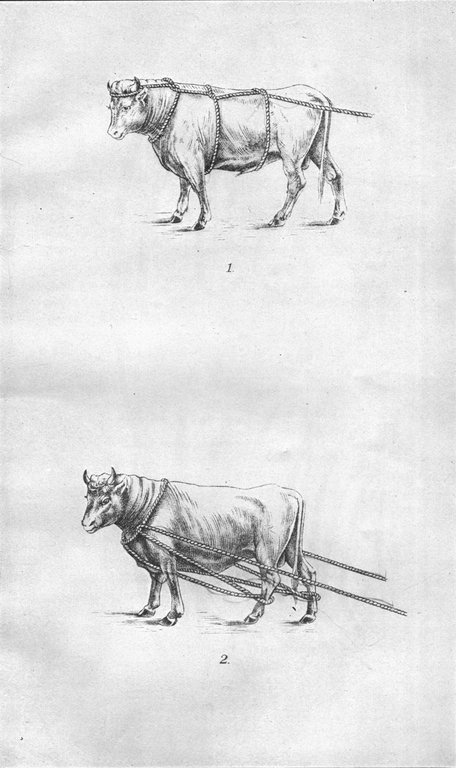
Methods of casting animals (Courtesy: geutenberg.org)
Cattle and buffaloes are cast for a variety of reasons: surgical operations, trimming of feet, and better control at a difficult calving. The most common and efficient method of cassting cattle and buffaloes is Reuff's method. 
Reuff's method of casting cattle and buffaloes minimized the chances of injuring either the animal or people attending it. A running noose is made at one end of a 10 m long rope and passed around the base of the horns. In the case of polled animals, the noose can be placed around the neck. A half hitch is made around the neck, the second around the heart girth, and passed back and looped around the animal just behind the hip bones. A steady pull on the free end will cause the animal to collapse slowly. It is advisable to cast the animal on soft grass or a bed of hay or straw.
An alternative method is shown in figure, in which middle of the rope is placed over the neck and the ends passed between the front legs. They cross under the brisket, are passed upward and crossed over the back and then downwards past the flanks and between the hind legs. Traction on the free ends will then cause the animal to collapse. The ropes must cross under the brisket (Not on the throat), or the animal will not go down.
One great advantage of the latter method is that, because there are no knots involved, it is easier to remove the rope when you are finished with the animal. With Reuff's method, the rope tends to stay in a better position. This is an advantage when casting wild or excited cattle because the rope can be put on in the crush. The animal is then let out of the crush and the process of casting can begin.
Casting is not recommended for pregnant animals because of the possibility of abortion. It can also result in bloat, pneumonia, or displacement of the abomasum.

Restraining the head, neck and legs of animals

The head is the first and most important area to restrain as it can seriously injure the handler when it is violently tosset about. The animal is much more likely to be still with its head restrained. The heads of cattle and buffaloes may be restrained by:
  • A self-locking neck clamp in the feeding passage
  • Haltering
  • Tying the neck to a fixture such as a stanchion or neck chain
  • Clamping the neck in a yoke or stanchion, and either holding the head down with a nose bar and tying it up with a halter or putting pressure on the nasal septum
The crush can be used to restrain the necks of animals, including cattle and buffalo.
The hind legs can be tied together (hobbled), but this technique should be used only in an emergency. The handler is in danger while hobbling a kicking beast. Cattle can become highly agitated during or after application of devices such as the crush, so constant supervision during the operation is essential.

FJ9U7ME3RAVM

Restraining animals: Devices - 2

 Restraining Animals: Devices - 1 can be found here.
Gags: A gag is a means for keeping the jaws apart for for probang use or examination of the mouth or teeth of horses, cattle, and buffaloes.
Several types of gags are in use, most are made of metal. The one in common use with large animals is called Varnell's movable gag. The bars of the gag or mouth piece fit into the interdental space. The tongue must always be free. The bars should be covered with rubber or leather to prevent damage to gums. Gags are also available for use with small animals such as sheep and goats. 
Bull Rings (Courtesy: shanahi.com)
Bull Rings: These are used for restraining powerful bulls. They are generally made of two semicircular pieces hinged together. They may be made of copper, aluminum, or some other alloy which does not rust.
There are large and small rings which are used according to the age and size of the animal. The ring is applied through the nasal septum about one cm back from the nostrils. A hole is first punched with a special bull puncher. When punching the hole, care should be taken not to punch it too far back. This is a common mistake. It results in too little space being available in that part of the ring lying outside the nostrils to accommodate a rope or a chain. Bulls are generally rung at the age of 10 to 14 months. Some bulls may need a new ring every year depending on the amount of wear and tear.
Muzzle (courtesy: sporthorse)
Muzzles: Three kinds of muzzles are in common use, namely leather, wire and string muzzles.
Leather Box Muzzle: This is the best type of muzzle, but it is expensive.
Wire Muzzle: This is less comfortable for the animal, but it is durable and inexpensive.
String Muzzle: This is a practical and inexpensive muzzle that can be made at home.
Muzzles are used to prevent animal
s from eating their bedding, to prevent biters from injuring people or other animals, and to prevent mares, etc. from biting their young ones. Calves are muzzled to prevent them from suckling their mothers. The muzzles should not be put on too tightly, otherwise the animal will resent its reapplication. Muzzles are taken off at feeding time.
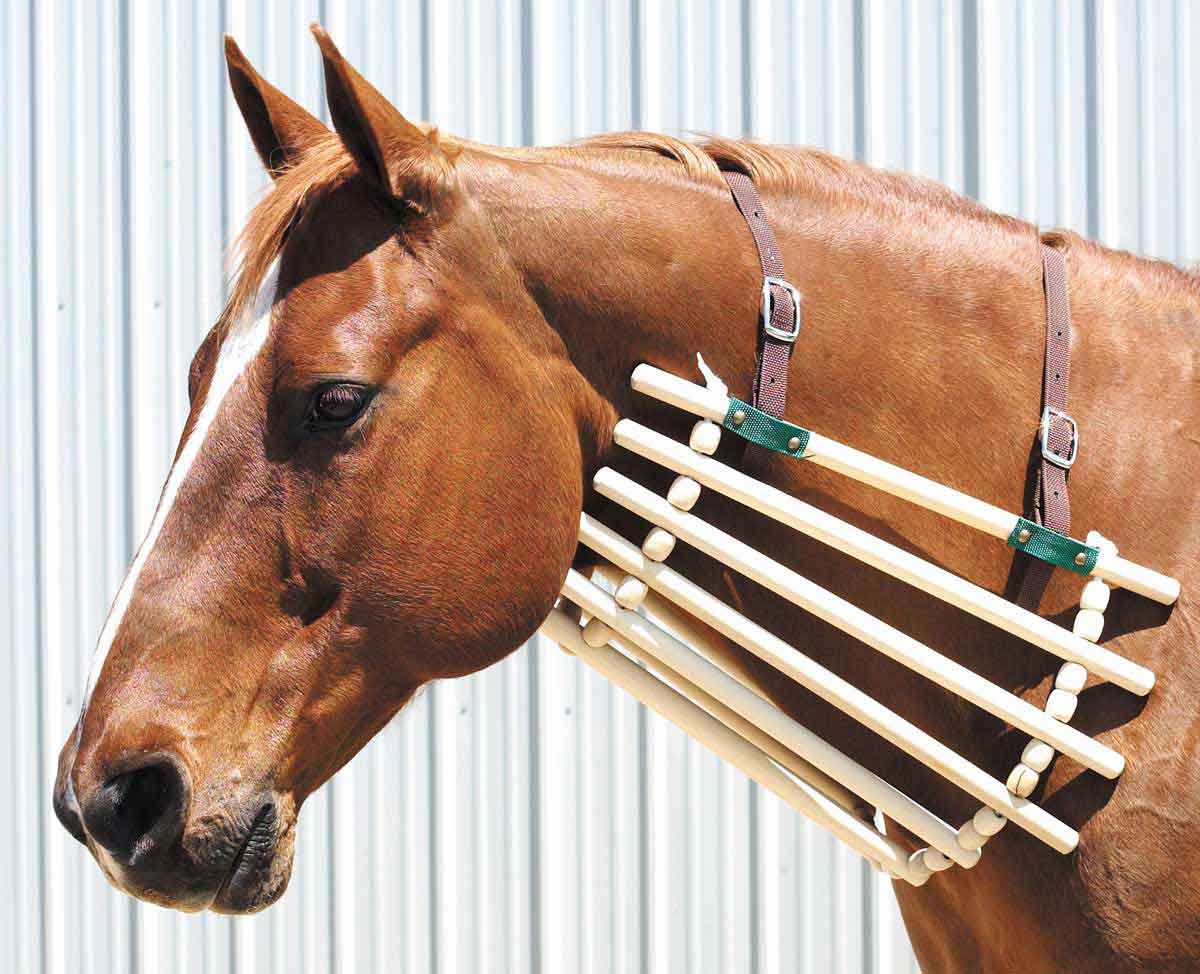
Cradle (courtesy: valleyvet.com)
Cradles: A cradle is a device consisting of 10 or 12 pieces of wood strung on two pieces of rope. A short piece of wood bored longitudinally is fitted in between long pieces. The long pieces are bored longitudinally at either end and a rope is strung through all of the pieces. Then it is put around the neck of the animal and tied along the crest. It is helpful when the animal must be prevented from getting its head to an injured or bandaged fore or hind limb or when medicine is applied to the body. It is also helpful in restraining a milking female when she wants to suck her own mild. Cradles allow very little vertical or lateral flexion of the head if properly applied.
Cattle Crush (courtesy: cashels.net)
Crushes: A crush (trevis) is a long, narrow alleyway for restraining animals in which animal's head is held in poles and the whole animal is firmly confined. It is especially useful for controlling large animals for operations such as dehorning, docking, and shoeing. Different types of crushes are used. These usually consist of four posts driven well into the ground and cemented there with two or more cross pieces at each side and end. Those at the end and/or the front are removable.
Ropes: Ropes are essential for restraining farm animals. Cotton rope is preferable because it is strong, safe and easy to use when making knots. Rough, hard ropes like coir should not be used since it can cause abrasions to the animals. Two sets of rope should always be kept ready: 
i. one about 2.5 - 3. cm thick and about 8 m long for sue in casting or securing large animals, and
ii. Two or three pieces, 1 - 1.5 cm thick and about 2 m long for securing small animals and the feet or horns of large animals. One or two lassos and rope halters should also be kept ready for any emergencies.

Restraining animals: Devices - 1

Halters: Halters are one of the simplest controlling devices for horses, cattle and buffalo. To make a halter, lay about 3 m of rope on the floor. At about 1 , from the left hand end, untwist the strands sufficiently to enable the right hand end to be passed through it to make a loop of about 2.5 cm in diameter. Lay the rope down as before. Close to the loop, untwist some strands again on the right hand side, and pass the left end through it. Pull up tight and bind the splice thus made with a few turns of string. To form a poll-piece, untwist the strands of the right hand length, about 25 cm from the loof already made, and pass the left hand end through it.
Make an overhand knot to fix. Bind on either side with string. Now pass the long right hand end through the spliced loop first made. This forms the nose-band. The halter is now complete. The knot in the poll-piece can be adjusted to fit the head of different animals.
To halter a horse, first slip the rope or shank of the halter around its neck by holding the forelock or resting the right hand on the neck just behind the ears. Then slip it over the horse's ears. The halter should be prevented from becoming too tight by putting a hitch or cinch in the shank as it leaves the nose-band. Placing the halter on the animals correctly should be practised until it becomes second nature. An incorrectly placed halter may be too loose to hold the horse, or may irritate it to the point where it becomes unmanageable.
Head Collars: Effective devices for controlling animals, head collars are used mostly with horses, but may also be used with cattle and buffalo. The head collar consists of a poll-piece, two cheek pieces, a nose band, a throat-piece, and a jowl-piece. Today, nylon head collars are increasingly being used because they are cheap, easy to clean, and durable.
A head collar is a very effective means for securing a horse in a stable or stall. A neck strap or neck rope is often used in the stable, but whether it is a halter or a neck tie, the shank in each case is put through a ring or hole in the manger, with the end attached to a metal or wooden "sinker" to prevent the horse from putting his foot on the head rope, yet allowing the maximum length of movement.
Fig 1 (Click to enlarge) - Courtesy: ryancoaxum.com
Horses may be tied to the rings that are often found in stalls or on the heel post. When tying a horse in a stable, it is best to use a knot that can be released quickly. A method of tying such knot is shown in Fig 1. The knot is made by doubling the head rope or the shank of the halter with one short end. This doubled piece of rope is put under the ring, and then another loop in the long end nearest the horse is inserted through the double end. The short end is pulled tight. A second loop is made in the short end, and this is put through the firsst loop and tightened by a pull on the long end. A quick tug on the short end releases the horse.
Twitches - Courtesy: fao.org
Twitches: A twitch is a tightening device used to restrain an animal. The different types of twitches are the stick twitch, halter twitch, loop twitch, and leg twitch. Twitches should be applied immediately before the necessary restraint is used. Since the device inflicts pain, repeated use should be avoided.
a. Stick Twitches:The stick twitch consists of a piece of stout wood about 1 m long with a 1.5 cm hole about three cm from the end. A piece of rope is inserted through this hole. While applying a twitch, the animal should be haltered and backed into a corner of the stable yard. Take the twitch stick under the right arm and stand on the near side opposite the left shoulder. Put the thumb and last three fingers of left hand trough the loop of the twitch, but leave the index finger out to prevent the loop slipping over wrist. Take the animal in confidence and get a good hold of the upper lip, leaving the nostrils free. With the right hand, rapidly twist up the stick. Take as tight a hold as necessary, but do not be unduly severe. The twitch helps restrain the animal by causing a harmless pressure upon a sensitive area of the upper lip. It also diverts the animal's attention from the part being manipulated and affords a strong hold upon the head of animal. If it is not possible t apply a twitch on the upper lip, then the lower lip or an ear may be used.
b. Loop Twitches: The loop twitch consists of a pliable rope with a running noose on one end. The noose is passed over the poll, into the mouth, and pulled tight. It should be used very carefully since it is liable to cut the commissures of the lips.
c. Leg Twitches: The leg twitch is an ordinary tourniquet applied about 10 cm above the knee or hock to immobilize the leg.

Continue... (Read about more restraining devices as gags, bull rings, muzzles, cradles, crushes and ropes in next post)

Restraining animals: Special Procedures

Lifting a foot or leg: To lift the front foot of an animal like a cow, the animal must first be restrained. Tie its head so that it cannot move about. Then stand beside the animal facing backwards, reach down and lift the foot, and bend it at the knee. Be ready; the animal will probably lean its weight on you as the foot comes off the ground. Lifting the hind leg is difficult and should not be tried without a proper stock to confine and support it. To get an animal to lift its foot a little, e.g. if its foot is on a rope you are working with, exert upward pressure with your foot on the underside of the dew claw of the appropriate foot. This will usually cause the animal to lift its foot off of the ground and replace it. Frequently, it will put its foot down in its former position, so you must be alert and free your rope while the foot is in the air. 
Holding: It is easiest to keep a standing sheep still by holding it against the pen side with your arms and knees. In an open area where there is no fence, the sheep can be straddled if it is not too large. Place one hand under the animal's chin, keep your back straight, and stand as far back as it is comfortable. A standing sheep can also be held in a neck yoke.
Lifting the animal: Many sheep farmers suffer "bad backs" each year from lifting sheep. Sheep are heavy, difficult to hold against your chest, likely to struggle, and cannot be gripped easily. All of these factors increase the risk of back injury. If possible, gates or ramps should be used instead of lifting. If, however, lifting is unavoidable, 
  • Do warm-up exercises
  • Keep a straight back
  • Bend your knees and legs to lift the weight
  • Lift smoothly and continously
Once goats are caught, they can be restrained by a firm hold around the neck at the base of the skull. If a difficult procedure is to be carried out, a collar should be used. As previously mentioned, fibre-producing goats such as Angoras should not be restrained by holding their fleece as this will cause excessive bruising under the skin.
Shearing: Two types of goats are kept for their fibre. Angoras produce mohair, whilst a variety of long haired types produce soft under hair or down known as cash-mere. Long haired Angora goats are restrained for shearing in much the same way as sheep are restrained for foot trimming. Cashmere may be harvested by combing or shearing with the goat normally restrained in a standing position. Both types may suffer cold shock after shearing and therefore may need proper housing for at least a few days depeending on the weather and the time of the year.
Artificial insemination: The preferred method for restraining the female goat to be inseminated is to hold her up with her head facing back between the handler's legs. Her rear end is raised up by lifting the bent back position makes the inseminator's job of locating the cervix using an illuminated speculum much easier. The insemination "gun" is inserted into, but rarely through, the cervix.
Parturition: Dairy goats are prolific. Thus the chance of two or three kids being dropped is high. This increases the possibility of malpresentation and the problem of kids becoming mixed up. Handler assistance at the time of birth is therefore a must. A dramatic but often successful method of inducing breathing in a newborn kid to is to hold the kid by the hind legs and swing it backwards and forwards or over and over with the kid describing a circle. This forces fluid out of the lungs and is often enough to stimulate breathing. If newborn kids are too weak to suck their mother's teat, it will be necessary to feed colostrum via a stomach tube. Care should be exercised to ensure that the tube is in the oesophagus and not in the trachea. Insertion of the tube is facilitated by holding the kid's head up with the neck extended.
Turning up sheep: If sheep are to be controlled for a long time, they are turned up with bare hands. First, the handler should stand on the left side of the sheep and place his left hand under the sheep's jaw. He should keep his right hand free to place behind the animals buttocks should it try to run backwards. After steadying the animal in this position, the handler should pass his right hand over the back to the other side, as far under the belly as possible and grasp the wool. The sheep's forelegs should be raised off the ground with the left hand, and with right hand the animal should brough to a sitting position on its hind legs and supported against the handler's legs. Hornless sheep are held in this position by holding their forcannons, while horned sheep can be held by their horns.

Restraining animals

Handling and restraining means controlling animals for various purposes such as:
  • Giving them medical treatment or surgical operations
  • Shoeing, drenching and checking ear tags or tattoos, taking blood samples, ringing, etc.
  • Examining the buccal cavity, eyes, feet, or any other parts which are not otherwise clearly visible.
  • Preventing biting of other animals or attendants.
Restraint can be effected by using various devices such as halters, head collars, twitches, muzzles, gags, side lines, and hobbles.

Containing animals

Fencing: Almost any livestock operation will require fencing of some sort. Fences may be used for control and movement of livestock, to keep the stock off cultivated lands, or as an aid to pasture management. Moreover, fencing is of great importance in maintaining good relationships with the neighbours.
Fences may be constructed from any materials which suffice to hold the stock including live hedges, brush corrals, stone walls, wooden planks, pipes or various types of wire. Only the last will be considered here. Wire mesh used for fence should be smooth and strong. Woven wires of 9-11 gauge are best for fencing. The size of mesh can be 30 cm square for large animals and 15 cm square for small animals. The height of the fence should be about 125 cm for large animals and 75 cm for small ones.
Fences can also be made of three or four strands of plain wire. For these fences the height of each strand from the ground upward should be 30, 60, 90, and 125 cm for cattle and buffalo, and 20, 35, 50 and 75 for sheep. Wire strand fences, however, are not very effective since animals can sometimes squeeze through the strands.
The line posts to which the wire has to be fixed should be spaced about 3m apart. The size of the fenced lot depends on the number of animals normally handled on the farm.
The gate is subjected to more wear than any other part of the fence. It must be easy to open towards either side. The width of the gate should be about 1.5 m.
Remember that when building or repairing fences, you will be working with nails, staples, and bits of wire. It is extremely important that care be taken not to scatter these materials on the ground since they may lead to foot injuries or get into the animal feed.
Handling yards: 
Handling yards are used for collecting and holding groups of animals. They contain various types of structures for performing different farm operations for different animals. These structures may include a central animal weigh bridge, cattle crush, dipping assembly, pens, cattle chutes, etc. It is advantageous and economical to construct one flexible handling yard that can be used for the main tasks on a farm, namely collecting and filing animals for weighing, dipping, vaccination, shearing, etc. The size and number of the different component pens of handling yards depends on the heads of stock to be handled.
Strong metal tubing, 7.5 cm angle irons, 20 cm x 7.5 cm split-wooden rails, or 15 cm x 5 cm sawed timber are ideal for such yards. Wire fencing is, not strong enough to contain animals, and solid walls are unsuitable because they make yards hot and hinder the worker's movement and obstruct his vision. At least four bars of tubing, angle irons, or timber should be spaced at heights of 25, 50, 75, and 100 cm from the ground upward for small animals; and 30, 60, 90 and 150 cm for large animals.

Transporting horses by train and vehicle

When horses are to be taken to a distant area, the train is considered to be the most effective mode of transportation. In Pakistan trains have special boxes or wagons reserved for horses. They can accommodate three to five horses and contain separate feeding and watering devices for each animal. There is a layer of bedding material on the floor for the animals' comfort.
The horse, wearing a head collar, should be led into the wagon from a platform. If the horse is overly excited, wait until it calms down, do not try to drag it. The horse can be tied to a ring attached to the manger. Talk to the horse and pet it. When the horse is tied, close the door or snap a chain across it quietly. Care must be taken with yearlings that have never been on a train. They can be a problem unless they have been handled constantly. If they have not yet learned to accept discipline readily, they can do a lot of damage. When it is time to release the horse, make sure that it has been untied before opening the door to the wagon. Unsnap the chain or open the door, walk away and let the horse come out at will.
It is best to start getting a horse used to a truck or trailer early in life and especially before a journey is planned. If a mare is an easy loader, the foal can be allowed to follow her on and off the vehicle, and young animals may be fed in and around it. Never allow the horse to come off the trailer or truck as soon as the ramp is down. Make it a habit to insist that the horse stand still for a few minutes. This will prevent it from rushing backwards to get off. This is a frequent cause of injury to horses and people, and can also damage equipment.
There are a number of useful techniques for loading difficult horses. The best method is to park the truck or trailer in an alleyway or up against a wall, so that there is no escape around one or both sides. One person should hold the head with the animal wearing a bridle. Place a new market loader, purchased or improvised, on the horse's quarters and have two reliable helpers each hold the handle of the loader. The two helpers should pull forward as evenly as possible and not give up. The person at the head should guide the animal in, but not pull too hard or the horse may be inclined to throw its head up. The pressure on the loins and buttocks appears to prevent the horse from both rearing and kicking, although it may produce a small buck on the first occasion it is used.

Transporting livestock by train and vehicle

Transport facilities for livestock are grossly inadequate in Pakistan. The stock owner has to use one of five ways to transport: by ship, train, plane, vehicle, or hoof. Transport by plane or ship, of course, isi usually reserved for costly race horses, zoo animals, and imported pure bred exotic cattle, etc. For long distances, rail transport, affords a savings on maintenance and handling charges, tolls, and other incidental expenses. Also, weight loss and death, potential consequences of transport by foot, can be avoided.
If rail transport is chosen, the wagons which are to carry livestock should always have a roof, provide for free passage of air, and have battened or non-slippery floors. In Pakistan wagons used for goods transport are generally used for transport of animals too. In such a wagon a 10 - 15 cm thick layer of sand should be spread on the floor. This prevents the animals from slipping, soaks up urine and makes lying down comfortable. The side doors should be left open for ventilation. Partitions of suitable size should be made using wooden poles to keep the animals on their feet while the train is moving.
Sheep should be packed in a wagon closely enough to prevent them from being thrown about during transit. Animals should be so grouped that those of approximately the same size and condition are loaded together. Horned cattle should be secured by the horns to the side of the wagon. They should stand head to tail so that alternate animals face the opposite directions.
It is necessary to carry the local feed and utensils for feeding, watering, and milking of animals during the journey. Two experienced attendants who can perform these tasks should accompany the wagon or truck load. Simple medicines for diarrhoea, bloat, fever, and injury should also be carried.
In the winter, the stock should be watered every 12 hours, once in the morning and once in the evening. In the summer, watering frequency should be at least three times a day. When a journey is of more than three days, off-loading for feed and rest is essential to maintain the health and well-being of animals.
Transport of livestock by vehicle has many advantages. It is very convenient to load the animals at the farm and directly transport them to their destination. Thus, the problems of repeated handling and associated disturbances, such as weight loss, can be avoided. On the other hand, if the journey is long and the roads unsurfaced, the cost of transport per Km is somewhat greater than it is by rail, and an extra strain is placed on the animals. Nevertheless, the advantages of vehicle transport outweigh the truck can then be taken to an earthen mound or any other raised geoplogical feature of convenient height and the animals loaded from the mound.
The precautions to be followed while transporting livestock by road are the same as for rail transport. An ordinary goods truck can take four to five cattle and buffaloes, or 20-25 small animals depending on their age and condition.
If goats are being transported in a vehicle, they should not be allowed too much space, otherwise they will be knocked against the sides as the vehicle moves. If only a few are to be transported, spare space can be filled with bales of straw. These must be firmly tied in place and should not provide the goats with any climbable surfaces or ledges. The ideal floor is a rubber mat covered with a thin layer of straw. Horned and dehorned goats should not be carried together in the same compartment. Goats should never be transported in a vehicle without a division between them and the driver.

Moving animals: Horses

Even though horses are social animals, strange horses should not be allowed to get too close to the others. When leading or riding in a line, keep at least one horse's length between animals to avoid kicking. Horses being introduced nose-to-nose for the first time will often squeal and strike out with a front foot or even try to turn quickly and kick. When crossing a road, it is extremely important that all the horses cross together. One person should take charge and check that all are ready to cross simultaneously or in larger groups. It is better to hold the traffic and let the whole line cross. If one horse is left behind, it could get out of control and cause an accident.
Similar precautions should be taken when turning a group of horses out into a field. All the horses should be taken into the field and held well apart and clear of the gateway. The gate should then be closed. They should all be turned to face the gate and, when all are ready, released together. Turning the horses to face the gate means that the horses have to turn before they charge off and the handlers have time to step clear.
In a situation where the person riding or leading the horse loses control of the animal, the others should try to remain calm and stand still. Trying heroically to rescue a bolting horse at a gallop will only make matters worse.

Transporting animals: Sheep and Cattle

It is much easier to move a group of sheep than to try to separate one or a few from a flock. It is sometimes more efficient to sort (draft or cut a small group from a large flock using a gate. A well trained dog or another person is essential. It is often easier to take the whole group to the yards even when just a few are needed.
There is a high risk of smothering when a large group of sheep is run through a narrow gap, such as a gate in a rotational grazing system. The risk is reduced by adopting the following measures.
  1. Move the group uphill where possible
  2. Place a person immediately before the gap to cut off the flow
  3. Be particularly careful when a downhill movement leads to a stream crossing, culvert, gate, or other narrow area
  4. Stresses such as the presence of dogs and noise should be eliminated if possible to let the sheep look ahead to see where they are going. When there is too much stress, sheep mill around climb on each other's backs.
Sheep can be driven easily by dogs or people. Sheep that are kept in restricted spaces like fields learn to respond to dogs by forming a group. Feral sheep, on the other hand scatter when attempts are made to muster them with dogs. Once domestic sheep are in a group, they try to maintain a certain distance (flight distance) between themselves and the dog and so move away on the dog's approach. Single sheep also maintain a flight distance. Whey they cannot escape, they are likely to turn and face the dog or run past it to escape from confinement.
When driving sheep along public roads, have one person at the front to warn oncoming traffic and control the rate of movement and a more experienced person behind to move them forward. Sheep are "followers" animals, and will therefore naturally follow other sheep. They will also follow people who feed them regularly.
For cattle and buffaloes, as well as sheep, driving is the most economical way to move the animals, at least for short distances. It is essential that an adequate supply of food and water be available at suitable points along the route. All farm stock should be kept to a a well defined track because,
  1. Facilities for feeding and watering will often be available, 
  2. Wandering animals may spread diseases in the region through which they pass and can be properly checked by authorities on well defined roads.
Animals lose body weight while moving, THis loss can be minimized by proper scheduling of feeding and watering. Indigenous cattle are well served if ad libitum water supply points are locaated about 20 Km apart. Mutton sheep going to market should get water at intervals of about 10 Km, otherwise they will lose a large amount of body weight.
Cattle, including buffaloes, can be driven easily for about 30 - 35 Km a day, and sheep for half that distance. In summer, driving during the hottest part of day should be avoided. Whenever possible, animals should be driven on soft ground and not on hard roads.

Handling animals: catching poultry

When catching birds, a smooth style of movement is essential as sudden movements will cause the birds to take avoiding action, and then they are almost impossible to catch. Such episodes can result in smothering when the birds run into corners, injury from fleeing, and reduction in egg production.
Older chickens can be caught by grasping the body with both hands over the wings. This prevents flapping which could cause injury to the bird and alarm the other birds in the flock. Firm but responsive handling will be more successful in keeping the bird comfortable, whereas loose holding of the bird may allow it to free one or more limbs with the risk of injury.
The ideal approach is not always possible, and one may have to resort to catching the chicken by the legs. Both legs can be grasped with one hand. The other hand is used to support the bird from below in an upright position. It can then be held with the legs grasped and the body resting on the hand to allow it to be handled for condition scoring, general examination, assessment of laying status, etc.

Handling animals: Horses and ponies

Anticipation is the key to safe handling of horses and ponies. Developing an awareness of the animal's natural behaviour and thus avoiding certain situations can enable handlers to prevent accidents. Most horses and ponies will behave better if handled with confidence, firmness, and kindness. Thrashing an animal will only produce fear and panic, and the horse or pony invariable stronger than the handler, will react instinctively and be less likely to perform the required activity. Wearing stout footwear is essential to give confidence to the handler. Boots or shoes with steel toe-caps are well worth considering as they protect the foot from trampling and enable the handler to stay close to the horse without fear of injury.
There are a number of tricks for catching difficult horses or ponies which are worth trying, depending on the circumstances.
  1. Always approach the horse or pony from the front and slightly to one side where it can see you. The animal's vision behind and directly in front is good. Speak as you approach in order to give it a warning. Handle the horse or pony first on the lower neck or shoulder as this a safe area. 
  2. Offer food over the fence. Some animals will then consider you to be a visitor rather than a catcher. This works best if the animal is wearing a head collar. It will usually submit once you have hold of the head.
  3. Try sending someone to catch the animal who does not normally ride the pony or who is dressed in clothing not usually worn when handling or riding.
  4. When an animal comes close but snatches its head away when you try to catch it, try crouching on the ground with some food close by. The unsuspecting animal may allow you to touch a front leg which you can then pick up. It then assumes that it is caught. Leaving a short length of rope or leather on the head collar may also help with a head-shy animal.
  5. Cornering a horse or pony with the help of two or more people some times works, provided it does not usually gallop off when you are still a long way from it. Try to avoid exciting the animal, and if possible let it move forward a little. Many animals will give up once they are cornered and allow themselves to be caught.
  6. Sometimes an animal can be difficult to catch even in a confined space because it is frightened or has been injured. In this case it may be necessary to use a lasso. If the animal cannot be caught with a lasso, a lariat can be tried. A lariat is a rope constructed with an extremely tight or hard twist and is used for holding and catching an animal. Knots are difficult to tie in a lariat because of the stiffness of the rope.
Many of the above techniques will be more effective if other animals are removed from the vicinity. Try not to chase the animal around the field. It will only make matters worse. Horses and ponies that have been handled well from birth are seldom difficult to catch. The handling they receive in the first few hours of life is particularly important in this respect.

Handling animals: Goats

Goat handling is strongly influenced by the fact that they seem to enjoy companionship and being handled once they have become used to it. Regularly handled dairy goats are often very friendly. Fibre-producing breeds seem to be more reserved, but even they soon get used to being handled, and in small numbers can be almost as amenable to handling as the dairy breeds. The exceptions are the males. Although rarely unfriendly, their strong, almost overpowering smell makes them unattractive animals to handle, and as a result they are often handled badly.
Catching goats: The inquisitiveness of goats can often be used to good advantage when an individual animal is handled. The group should be approached quietly and in a friendly manner. The handler should enter the pen and, if necessary, pretend to carry out some task to attract their attention. They will almost certainly crowd around, and then it is a simple matter to hold one. Although goats are very inquisitive, they are also cunning and soon learn when the handler is trying to catch one of them, so care should be taken to avoid a time-wasting chase. Once goats are caught, they can be restrained by a firm hold around the neck at the base of the skull. A collar should then be used. Fibre-producing goats such as Angoras should not be restrained by holding their fleece, as this will cause excessive bruising under the skin.
Goats are natural followers and should be led rather than driven when ever possible. A lot of time can be saved if the goats are taught to recognize a food bucket or bag. They will usually follow a handler into a pen if they think they are going to be fed. Goats that are not used to regular handling, such as some fibre-producing types run out on hill land, will need to be handled for some routine treatments, e.g. vaccination and drenching.

Handling Animals: Sheep

Preparation: Prior to actual handling, it is wise to have though through all the tasks and possible responses of the sheep. Are all the facilities, tools, chemicals, and protective clothing ready? Are there sufficient people on hand having the necessary skill? Is the route ready, with all unnecessary avenues blocked off? Once handling has started, such preparation helps the job to go smoothly and lessens delay due to unforeseen events.
Risk of injury: Because of the relatively small size of sheep, we tend to lift and move them manually, often with a bent back. Such action may cause low-grade back injury with a cumulative effect.
Although sheep are generally not aggressive towards people, they sometimes cause injuries. Rams, particularly during the mating season, may attack with sufficient force to cause serious leg or back injury. Remember that sheep do not sense their environment in the same way as humans. They have eyes at the sides of their heads and can almost see behind themselves without turning their heads.
Arousal: Here are some common factors that tend to incite or arouse sheep:
  1. Visual isolation from other sheep
  2. Proximity of dogs or people
  3. Hunger or thirst
  4. Sexual activity
  5. New environments
  6. Unusual loud or high frequency sounds
The following factors decrease arousal:
  1. Proximity of other sheep
  2. Low-frequency noises such as the "rumble" call of a ewe to her lamb, or the courting ram to an oestrous ewe
  3. Low illumination, as in covered yards.

Handling animals: Cattle

Skills and risk of injury: Good cattle handling is a skill which gets a job done safely, humanely, and quickly. Most cattle handling can be done with out physical exertion. It is best done with ingenuity and patience - not by force. By understanding the behaviour of cattle, actions can be predicted and thus directed to give the required response.
Cattle can cause injury to handlers in a variety of ways. At up to 800 Kg as an adult, a bull's weight is sufficient to knock down, trample, or crush a against wall or fence, either intentionally or accidentally. Bruised or broken toes may result from trampling by cattle unless protective foot wear is worn. Cattle and buffaloes use their heads to attack and to defend themselves. If horned, they can inflict severe damage when they attack with the head. A quick thrust sideways or forward can be fatal. They can butt with with great force and inflict injury even when polled or dehorned. Dairy bulls are particularly dangerous. Cattle/buffaloes usually kick with one hind leg at a time in a forward, outward, or backward movement, and so can stricke someone standing at their shoulder. Cows are particularly protective in the first day or two after calving and may attack anyone approaching their calves. Tail switching can cause injury to unprotected eyes if they are struck by the long hairs at the end of the tail.
Welfare: The welfare of animals is very important. It is our obligation to maintain their well-being. The whole handling procedure is easier when animals are relaxed. People with dairy farm experience generally accept that dairy cows are easier to handle when they are comfortable, that is, when they are clean, dry, and away from drafts.
Animals should be kept calm so that they move and stand quietly. Cattle should be allowed to settle down for 20 minutes or so after yarding. Control of arousal is fundamental in controlling the movement of animals. Handling, by its very nature, stimulates animals and raises their excitement level. Humped cattle have a reputation for being more difficult to handle in yards. It should be kept in mind that an animal's response to a stimulus depends not only on the type and intensity of the stimulus but also on the unique temperament of the animal.
Social Behaviour: Cattle and buffaloes are social animals, forming attachments and living naturally in groups. When a group is being formed or added to, there are usually conflicts among animals which are expressed by fighting, withdrawing, appeasing, etc. In this way two animals sort out which one has priority of access to something desirable like a patck of grass or a good place to lie down. This establishes a social herarchy which works for the befit of the herd. The struggle for dominance is especially noticeable in the case of cattle. When a social heirarchy is set up in a herd of cattle, it usually lasts for a long time.
When an animal is taken out of the group for more than a day, there is usually considerable antagonism shown towards this animals from the others when it returns. This can result in a drop in milk production in cows or physical damage among bulls. The animal should, therefore, be returned as soon as possible. If the animal has been away for more than a day, it is better to return it when the other animals in the group are engaged in some activity and too distracted to get involved in a fight. Fighting among cattle, particularly bulls, occurs when familiar and unfamiliar animals are mixed together in a group. The increased muscle activity results in elevaated pH of carcasses and dark, firm, dry meat.
Psychological behaviour: Early experiences can have a lasting impact on cattle and buffaloes, so it is especially important to exercise care and caution when handling an animal for the first time. One bad handling experience may be remembered by the animal for as long as three years. If cattle are handled gently from youth, they will be much easier to handle later, for example, when being loaded into a vehicle for transportation. If an animal has been handled badly when driven into yard, for example, it will be much more difficult to get it back into that area again. A handling system must be well established from the outset and made to work the first time.
From an early age, animals should be trained to accept and expect a daily routine. Cattle readily learn to accept routine, and routine makes dairy milking and handling much easier and productive. Animals even become so used to routine that small changes in their environment, such as a change of milker, can create excitement and result in a pronounced drop in productivity.
Handler characteristics: The attitude of the handler is very important. Impatient handling may cause injury and affect production dairy cows. A confident milker usually obtains higher yields. It is commonly believed that animals can detect a handler's lack of confidence. Handlers who are unsure of themselves certainly do not have good control over animals and so fail to get the desired responses from them. A new handler should therefore learn proper techniques from the start and keep practising them regularly.
Handling animals with minimum disturbance also increases the opportunity for heat detection the dairy herd. The animals' response to the stimulation of handling may point to certain conditions such as hypomagnesaemia or lameness.

Approaching animals for handling and restraining

General Precautions:
  1. When approaching an animal in a shed, stall, or paddock, always speak to it before touching it.
  2. Approach the anoimal from the left side and handle from the head or near the head (beware of the horns of cattle and buffalo).
  3. It is not advisable to carry a stick, but if one is needed it should be kept out of sight of the animal.
  4. Get some information about the animal from its attendant or owner, e.g. whether the animal is calm or aggressive.
  5. Treat strange animals with suspicion, but try not to let the animal know that you are afraid of it.
  6. The animal should wear a head collar or a halter. If required, use two ropes on the head collar and tie one to each pillar ring. (Two ropes are especially needed when working with stallions or bulls).
  7. Never handle the hind quarters or hind legs without having the animal's head held and a foreleg lifted or restrained.
  8. Take hold of the forelock (in the horse), ear, or nose until a halter has been put on. Do not grasp the nose too tightly, otherwise breathing may be obstructed.
  9. It is important never to make a sudden snatch at the animal's head collar. This alarms the animal and may make it suspcious on future occasions. 
  10. Keep in mind that some animals kick backwards, some forwards, and other laterally with their hind legs. some cattle can kick all three ways.
  11. Bulls, especially over a year old, are often treacherous and should be properly secured before being approached by a stranger. They are usually rung before they are one year old. It is wise not to trust a bull.
  12. When haltering horned animals, it is best to slip the poll-piece of the halter over the horns and ears before adjusting the loop around the nose, so that the animal cannot take the halter off and break loose.