Showing posts with label cattle. Show all posts

Functions of various parts of the digestive tract: Mouth, Oesophagus

Mouth:
The primary function of the mouth include prehension (grasping), mastication (chewing), and mixing of feed with saliva as preparatory steps for subsequent digestion in the remaining parts of the alimentary canal. The lips, tongue, and teeth are used to pick and hold feed while it is in the mouth. The teeth grind the feed, and the tongue mixes it with saliva. The lips of sheep, goats, and horses are flexible, while those of cattle and buffaloes are relatively stiff and immobile. In horses, the upper lip is very sensitive and mobile and is used to feel the feed and direct it towards the moouth. Horses also have both upper and lower incisors which cut herbage like scissors and help in prehension. The mastication of feed with grinding molars is also very efficient in horses. In cattle, buffaloes, and sheep, the upper incisors are absent. Instead, they have a hard pad called the dental pad. During grazing, the tongue is used to guide feed into the mouth, and plants are grasped between the dental pad and lower incisors and torn away.
Saliva is a watery solution containing small amounts of mucin, inorganic salts and enzymes. It is secreted into the mouth from three pairs of salivary glands (paratoid, sub-maxillary, and sub-lingual). Secretion of saliva increases during mastication of feed. Cattle and buffaloes produce 130 - 200 litres, sheep and goats 2 - 3 litres, and horses 10 - 12 litres of saliva per day. Saliva lubricates the ingested feed and thus facilitates swallowing. It also helps in maintaining optimum pH in the rumen and provides a mechanism for recycling urea in ruminants.
Oesophagus:
This is a muscular tube extending from the back of the mouth (pharynx) to the stomach. Ingested feed is forced through the oesophagus by its wavelike muscular contractions.

(Note: In next Post, find about Function of stomach in digestive system of farm animals)

Parts of digestive tract

The digestive tract, also known as the alimentary canal, is a tube like structure extending from the mouth to anus. The different parts of the digestive tracts of ruminants and non-ruminants are illustrated in figures. The alimentary canal is comprised of the following parts,
  1. Mouth (lips, tongue, gums and teeth) and pharynx
  2. Oesophagus
  3. Stomach (In ruminants, the stomach includes the rumen, reticulum, omasum, and abomasum)
  4. Small intestine (duodenum, jejunum, and ileum)
  5. Large intestine (caecum, colon, and rectum)
  6. Anus
In addition to the above, the following accessory organs/glands also take part in the process of digestion: salivary glands, liver, gall bladder, and pancreas.
Among domestic animals, the proportion of the digestive tract to total body weight is higher in ruminants than in non-ruminants, as shown in table. Horses, for example, have a large caecum (15.6% of the total alimentary tract) where extensive microbial fermentation of plant materials takes place. Similarly, rabbits also have a well developed caecum. In ruminants, the stomach compartments (rumen, reticulum, omasum, and abomasum) occupy the major part (62%) of the digestive tract. Large variations in the proportion of different parts of the digestive tract in farm animals reflect differences in their feeding habits. These variations have evolved over time, and the animals have gradually adapted to various feed resources.


Cattle
Buffaloes
Sheep/Goats
Horses
Dogs
Body Weight (Kg)
450
600
50
450
20


Volume in liters, and proportion of body weight (percent)
Stomach


Reticulo-rumen
97.6
(48)
130.3
(48)
10.7
(56.7)
-
-
Omasum
15.8
(7.6)
20.9
(7.6)
0.6
(3.3)
-
-
Abomasum
11.8
(5.8)
15.7
(5.8)
1.3
(6.7)
8.0
(8.9)
1.0
(63)
Small Intestine
50.9
(25)
67.7
(25)
3.8
(20)
27.0 (30.0)
0.37 (23.0)
Caecum
7.7
(3.8)
10.3
(3.8)
0.6
(3.3)
14.0 (15.6)
0.02
(1.0)
Large Intestine
19.7
(9.5)
26.0
(9.5)
1.9
(10.0)
41.0 (45.6)
0.21 (13.0)
Total
203.5
270.9
18.9
90.0
1.6

Introduction to Digestion in Farm Animals

Digestion in animals involves mechanical, enzymatic, and microbial processes in the gastrointestinal tract, which convert large feed particles to a size which can be absorbed, transported, and used by the animals. The digestive systems of all farm animals are not the same, rendering them less competitive and able to adapt to a wide range of available feed resource niches. Based on the structure and functions of the digestive tract, farm animals are divided into two major groups:  ruminants or polygastrics, e.g. cattle, buffaloes, sheep, and goats; and non-ruminants or monogastrics, e.g. horses, donkeys, rabbits, dogs and cats. The key difference between these two groups of animals lies in the structure of the stomach. Ruminants, as opposed to non ruminants, have three additional stomach compartments where digestion takes place in different environments. In general, for farm animals the processes associated with digestion include prehension, ingestion, grinding or mastication, digestion of feed, absorption of nutrients, and excretion of waste products.

Artificial Insemination (AI)

Artificial insemination (AI) is the deposition of semen in the cervix by the artificial means. It is a useful technique devised for the genetic improvement of farm animals. Artificial insemination is widely used for breeding cattle, buffaloes, sheep, goats, horses, dogs and a variety of laboratory animals.
Advantages of artificial insemination

  • The greatest advantage of artificial insemination is the opportunity to spread superior germ plasm by the wide use of carefully tested and selected sires. On average, a bull can sire 50,000 progeny per year through artificial insemination compared to 40 - 50 progeny through natural mating. 
  • Artificial insemination plays an important role in the control of various diseases, particularly the venereal diseases disseminated by natural mating. 
  • It helps to maintain complete and accurate breeding records, leading to better herd management and the identification of infertility problems. 
  • Artificial insemination is more economical than natural mating. 
  • The mating of animals of different sizes becomes possible without any accidental injury. 
  • Artificial insemination extends the usefulness of sires of high genetic merit which for physical reasons are unable to copulate normally.
Limitations of artificial insemination
There are few disadvantages of artificial insemination even if it is properly performed. The major limitations are due to lack of trained personnel to provide proper service. Poor breeding efficiency may occur in herds when owners do not watch their animals closely for estrus and the inseminator does not breed them at the proper time. The inseminator may be, if not careful, a means of spreading infections from one herd to another. Herd owners should avoid intensive use of a limited number of sires, which may increase inbreeding in the herd. Increased inbreeding is usually associated with low fertility and decrease in vigor and overall productivity.
Semen and its collection
One of the most important steps in an artificial insemination program is the collection of semen and its proper handling. The following methods are used for the collection of semen from bulls.

  1. Artificial vagina method 
  2. Massage Method 
  3. Electro-ejaculation method
The best procedure and practical method for collecting semen is with an artificial vagina. Various sizes and shapes of artificial vagina are used, but all consists of a heavy rubber cylinder with a rubber lining inside. This enables a clean, complete ejaculate to be collected in the glass tube fitted on the lower end of the artificial vagina.
In the massage method, the operator's hand is inserted about 10 inches into the rectum of the bull. The vesicular glands are picked up with the fingers by carefully feeling the rectal wall. They are then massaged gently causing a slightly turbid fluid to appear which cleanses the path for semen. Then the operator massaages the ampulla of the vas deferens until the sperm containing semen appears. The semen is collected in a test tube placed in front of the sheath.
Electro-ejaculation is the method used for males that refuse to serve the artificial vagina or when injuries makes this impossible. A rectal probe with either a ring or straight electrode is used to provide the necessary electrical stimulation.
After the semen is collected, it is evaluated for quality (live and dead sperm, motility etc) and diluted with suitable extenders (diluent). Then it is stored in liquid form in the refrigerator at 5 Degrees Celsius or in frozen form in liquid nitrogen at below 196 Degrees Celsius.
Insemination procedure.
Detection of heat (estrus) of the female is the first step. When a female is found to be in heat, the inseminating rod is passed through the spiral folds of the cow's cervix by the recto-vaginal technique. Part of the semen is deposited in the uterus, just inside the cervix, and the remainer in the cervix while the rod is withdrawn. Extra care must be exercised in the case of those animals that have been inseminated previously. If pregnancy is suspected in an animal, insemination should not be repeated.
Spermatozoa can survive in the genital tract of a cow or buffalo for a little over 24 hours. The egg has a short survival time, about 6 hours at the most. Optimum fertility is obtained when inseminations are performed 13-18 hours before ovulation. Reasonably good results are obtained even during the period 7-12 hours before ovulation. The cows should be checked twice daily with a teaser bull to detect estrus. As a rule of thumb, cows showing estrus in the morning should be bred the same day in the afternoon, and cows showing estrus in the afternoon should be inseminated the next morning.

Reproduction In Farm Animals: Female Reproductive System

Female Reproductive Tract - Cow (Courtesy: fao.org)
The female not only contributes the female sex cell (ovum) but also provides the necessary environment in which the new individual is nourished during the early days of its life. These functions are performed by the primary and secondary organs of the reproductive system. A pair of ovaries are the primary organs of reproduction and produce not only ova but also the hormones required for the normal sexual behavior of females. The secondary organs of reproduction are a pair of oviducts (Fallopian tubes), the uterus, the cervix, the vagina, and the vulva. The mammary glands are also considered an accessory sex organ as they are closely related to the completion of reproduction by the nourishment of the young one.
The development of the reproductive organs starts before birth during the embryonic stage, but they remain quiescent. After birth, the reproductive organs develop gradually until the female attains a specific weight at a certain age when she becomes sexually mature, i.e. capable of producing viable gametes. The age at which a female becomes sexually mature is called puberty.
(a) Ovaries: The cow or buffalo has two ovaries situated on either side of the medial line, deep in the pelvic cavity almost at the border of the abdominal cavity. The right and left ovaries are connected with the uterine cornua of each side by tortuous Fallopian tubes. The ovaries of the buffalo are irregularly oval or spherical in shape and variable in size, while the ovaries of the cow are usually ovoid or spheroidal. The size and weight of active ovaries change frequently due to the formation of Graffian follicles and corpora lutea. A functional ovary develops from outer germinal epithelium from which the Graafian follicle develops.
The ovaries are the primary organs of reproduction because they produce not only the egg cells (ova) but also the sex hormones essential for female sexual activities. Willingness to mate (libido), ovulation, and many processes related to development, maintenance, and delivery of the calf are regulated by the female sex hormones. Hormone production in the ovaries is primarily controlled by the gonadotropic hormones of the pituitary gland. Under the stimulation of the pituitary hormones, the ovaries produce a follicular stimulating hormone (FSH), which is an estrogenic substance. Estrogens induce the psychic manifestations of estrus (heat). They also bring about glands of the cervix to secrete, and promote development of the mammary duct system. The characteristics behavior of the female and the secondary sex characteristics of the female are largely due to the influence of estrogens.
When ovulation takes place, the ruptured cells form the corpus luteum. The corpus luteum becomes a temporary endocrine organ under the influence of the luteinizing hormone  (LH) of the anterior pituitray. The corpus luteum secretes a hormone called progestrone which prepares the endometrium for the implantation of fertilized ovum and the maintenance of pregnancy. Progestrone also prevents ripening of additional follicles and ovulation, thus preventing the occurrence and manifestation of heat. It also stimulates the growth of the alveoli of the mammary glands and depresses the production of luteinizing hormone by the pituitary. The corpus luteum also produces another hormone known as relaxin, which causes decalcification of the pelvis. This results in the relaxation of the birth canal during parturition.
(b) Tubular Genitalia:
The tubular genitalia consist of the oviducts or Fallopian tubes, the uterus, the cervix, the vagina, and the vulva.
Oviduct or Fallopian tube. The oviduct is a tortuous, tubular structure of muscular and epithelial tissues. It reaches from the ovaries to the tapered end of the uterine horn. In cattle of different ages, the oviduct varies in length from 20 - 35 cm, while the length of the oviduct in buffalo varies from 20 - 25 cm. On the basis of diameter and internal structure, the oviduct consists of three parts: the isthmus or narrow portion which adjoins the uterine horns; the ampulla, which is slightly wider; and the infundibulum, which opens into the peritoneal cavity.
Uterus. The uterus consists of a body and two "horns". It is a muscular and irregularly tubular organ, the size of which increases during successive pregnancies. In heifers, it is situated 25 - 40 cm from the vulvular opening, just anterior to the cervix.
Cervix. The cervix or the neck of the uterus is a small muscular tube which extends from the uterus to the vagina. The muscular wall of the cervix is thick and its mucosa contain a large number of mucus-secreting cells. The mucosa form thick folds; opposite folds tend to overlap, forming a spiral passageway through the cervix. This makes possible the tight closure of the cervix with a cervical plug that is formed during pregnancy. This structure and secretions from the mucus secreting cells protect the uterus from microorganisms commonly present in the vagina. The cervical muscles relax during estrus and at the time of parturition. At parturition the cervix dilates, allowing the calf and fetal membranes to be expelled.
Vagina. The thin but elastic-walled tubular connection of the cervix with the vulva is called the vagina. It is a common passage for the reproductive and the urinary tract. The epithelial lining of the vagina undergoes changes during the estrus cycle. During natural breeding, semen is deposited in the vagina near the cervix.
Vulva. The external opening of the female genitalia is called the vulva. It includes the clitoris and the vestibule. The clitoris is a structure of erectile tissue (homologous with the male penis) located just inside the lower junction of the vulvular lips. The external opening of the reproductive tract of the cow lies just below the anus. It is about 12 cm long and has a wide, rounded dorsal angle and a narrow ventral angle. The thick labia majora are covered with fine hair.

Reproduction In Farm Animals: Male Reproductive System

One of the fundamental laws of nature is that every species makes a vigorous attempt to reproduce its kind. The higher animals reproduce sexually. This involves the production of potentially differentiated sex cells by the male and female. In animals, this has led to the development of highly specialized body parts for the specific purpose of reproduction.
Male Reproductive System:
Male reproductive tract of a bull (Courtesy: iaea.org)
The primary sex organs of the male are the two testes, which are normally located in an external sac of skin called the scrotum. The secondary sex organs are the duct system (the vas deferens), the epididymis, and the penis. The penis is trans-versed by the urethra, which is common passageway for urine and semen. The semen is composed of sexual secretions and spermatozoa. Besides the reproductive tract, there are a few accessory organs like the prostate gland, a pair of seminal vesicles, and two Cowper's glands, or bulbo-urethral glands. The primary, secondary and accessory sex organs are collectively called male reproductive tract.
(a) Scrotum: The scrotum is a two-lobed sac developed from the invagination of inguinal skin to accommodate the testes. The scrotum is pendulous and situated just behind the rear part of rudimentary teats in the inguinal region. Although the scrotum is apparently divided into two almost equal halves by the median vertical band, the left half is slightly longer and more voluminous than the right half.
The main function of the scrotum is to support and protect the testes suspended by the spermatic cord in the scrotal sac. The scrotum functions as a heat-regulating mechanism in the male. It keeps the testicles 4 - 5 degree celsius below normal body temperature. This lowered temperature is essential for spermatogenesis. The large number of sebaceous and sweat glands on the scrotum help in lowering the scrotal temperature. During the hot season, the thermoregulatory action of the tunica dartos muscles causes it to relax, allowing the scrotum to elongate, dropping the testes far from the heat of the body. During the cold season, the scrotal muscle contracts, retracting the scrotum and bringing the testes nearer to the body. This thermoregulatory action, however, does not begin until the animal approaches puberty.
(b) Testes: The testes are the primary sex organs in the male. They are found in pairs suspended in the scrotal sac by the spermatic cord outside the abdominal cavity in the inguinal region. Each testis is an independent unit, separated from the other in the scrotal sac. The testes are firm and compact masses of parenchymatous tissue. In the buffalo bull, the average length, breadth and circumference of the testes without epididymis have been reported to be 7.73, 4.32, and 12.22 cm respectively.
The testes develop within the abdominal region near the kidneys. They commence their descent from the abdomen into the scrotal pouches during fetal development. Migration is normally completed by the time of or soon after birth. Either one or both of the testes may, however, fail to descend into scrotum during maturity. This condition is known as unilateral or bilateral cryptorchidism. Bulls affected by bilateral cryptorchidism are sterile. This condition is thought to be an inherited trait, hence such bulls are not selected for further breeding.
The main functions of the testes are,
(i) Production of viable, potentially fertile spermatozoa,
(ii) Production of androgens or the male hormone, testosteroone.
The seminiferous tubules produce spermatozoa from the germinal epithelial layer by a series of cell division. The seminiferous tubules join to form the rete testes in the mediastinum, and these, in turn, lead in to a dozen efferent ducts, the vasa efferentia, which finally converge at the dorsal part of the mediastinum to form the begining of the epididymis.
The main sex hormone, tesstosterone, is secreted by the Leyding cells or interstitial cells of the testes. The secretion of this hormone is regulated by the luteinizing hormone of the anterior pituitary gland. Testosterone is responsible for the development and maintenance of the functions of the male reproductive tract, secondary sex characteristics and sexual behaviour.
(c) Epididymis: The epididymis emerges from the joining of the vas efferentia at the dorsal part of the testis. It is a very long single duct, highly vonvoluted and appearing as a mass of tubes. It is comprised of three parts: the caput epididymis (head), the corpus epididymis (body) and the cauda epidiymis (tail). The tail of the epididymis opens into the vas deferens.
Throughout most of its length, the epididymal tube is lined with secretory cells. Spermatozoa accumulate in the epididymis and mature during their passage through it. In the epididymis, the spermatozoa mature and become able to move spontaneously and fertilize the ovum (egg) when they come in contact with it.
(d) Vas deferens (ductus deferens): The vas deferens is a tube emerging from the tail end of the epididymis. It starts from the base of the testes, extends upward, and in association with the spermatic cord runs through the inguinal ring, where it separates itself from the arteries, veins, nerves, and other cord tissues. It passes through the abdominal cavity towards the pelvis and finally empties  into the urethra. The lumen of the vas deferens is narrow and lined with mucous membrane. The wall is made up of longitudinal and circular layers of involuntary muscles covered by the outer layer of the peritoneum. The muscles of the vas deferens contract involuntarily during ejaculation of semen and help in the expulsion of spermatozoa. In the pelvic region, the vas deferens enlarges to form the ampulla of Henle which is 4 - 7 inches long. The ampulla has numerous glands, and spermatozoa often accumulate heree before ejaculation. The glands of the ampulla secrete fructose and citric acid which provide nutrition for the spermatozoa.
(e) Urethra: The urethra is the common passage for the excretion of urine and semen. It extends through the pelvis and the penis and ends at the tip of the glans penis as the external urethral orifice. In the urethra, spermatozoa mix with the seminal plasma of the accessory sex fluids at the time of ejaculation.
(f) Penis: The penis is essentially composed of erectile tissue. It is divided into three portions: the attached portion is called the root, the main portion is called the body, and the free portion is called the glans penis. The erectile tissue is a sponge-like system of blood vessels which becomes filled with blood under pressure when the bull is sexually stimulated. This helps the penis to enlarge and become rigid, thus enabling it to enter into the vagina of the female.
The penis of the bull contains very little erectile tissue. The length of the penis from the neck of the pelvic urethra to the tip ranges from 65 - 111 cm. The penis is a cylindrical organ with a tapering end; the tapering portion opens at the angular end of the triangular sheath. The sheath of the buffalo bull is a pendulous triangular fold of skin extending backward from the umilicus. When the bull is not sexually excited, the penis is in a "S" - shaped from tknown as a sigmoid flexure. During erection, the longitudinal flexure straightens, thereby increasing the length of the organ. The erector muscles pull the penis against the pelvis and aids in erection by compressing the veins of the penis. The retractor muscles help to return the extended penis to flexed state.
(g) Accessory sex glands: The accessory sex glands of the male reproductive system are a pair of seminal vesicles, the prostate gland, and Cowper's glands or transverse urethral glands. They provide the bulk of seminal plasma.
Seminal Vesicles. Each of the two seminal vesicles are located on either side of the ampulla. The seminal vesicles are lobulated and highly secretory. They open either above or below the opening of the vas deferens. The secretions of the seminal vesicles contains a large amount of fructose and citric acid, which are required for the nourishment of spermatozoa. 
Prostate gland. The body of the prostate is situated in front of the vesicula seminalis on the dorsal surface of the pelvic urethra near the neck of the urinary bladder. It secretes a mineral rich fluid.
Cowper's glands or transverse-urethral glands. The Cowper's glands are two in number and lie one on each side of the pelvic urethra, partially buried in the transverse-cavernous muscle. They produce a viscid, mucous like lubricating substance.
Semen. The reproductive sexual fluids containing spermatozoa (product of seminiferous tubules of testes), secoretion of the epididymis, and the secretions of the accessory sex glands mixed in the urethra is known as semin. The semen is creamy-white to yellowish in color, and its consistency varies with the number of spermatozoa in the semen. A buffalo bull produces 1.5 - 6 ml of semen per ejaculation.
The discharge of semen during mating with a female or in an artificial vagina is called ejaculation. Nervous stimulation creates muscular contractions of seminal tract which ejects spermatozoa into the penis through the pelvic urethra. As a result of rhythmic contractions of the urethra, the semen is forced out through the orifice of the penis with a sudden thrust of very short duration.

Casting animals

Precautions before casting:
  1. Fast an animal for up to 12 hours before casting. If the animal has a full stomach, it may rupture during casting.
  2. There should be sufficient labor available to complete the manoeuvre in the shortest time with the least distress to the animal. It is necessary to have a reliable person at the animal's head in order to control it. Depending upon the size of the animal that must be cast, either two or three persons are needed to pull on the rope.
  3. The site for casting should be chosen carefully. The best choice is a well=grassed field where there is sufficient space and no objects which could cause injury. In bad weather a barn is suitable. There should be plenty of clean straw put down to make the animal's fall as comfortable as possible.
  4. A strong webbing halter or head collar must be used. There must not be a bit in the horse's mouth and any twitch that has been used in adjusting ropes must be removed.
  5. Any operations on the feet necessitate the removal of shoes. This is particularly necessary if hobbles are to be used in casting.
Casting Cattle and Buffaloes:
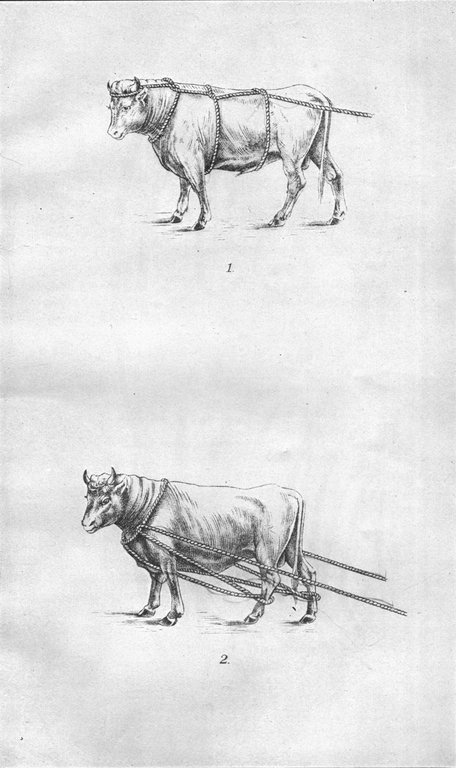
Methods of casting animals (Courtesy: geutenberg.org)
Cattle and buffaloes are cast for a variety of reasons: surgical operations, trimming of feet, and better control at a difficult calving. The most common and efficient method of cassting cattle and buffaloes is Reuff's method. 
Reuff's method of casting cattle and buffaloes minimized the chances of injuring either the animal or people attending it. A running noose is made at one end of a 10 m long rope and passed around the base of the horns. In the case of polled animals, the noose can be placed around the neck. A half hitch is made around the neck, the second around the heart girth, and passed back and looped around the animal just behind the hip bones. A steady pull on the free end will cause the animal to collapse slowly. It is advisable to cast the animal on soft grass or a bed of hay or straw.
An alternative method is shown in figure, in which middle of the rope is placed over the neck and the ends passed between the front legs. They cross under the brisket, are passed upward and crossed over the back and then downwards past the flanks and between the hind legs. Traction on the free ends will then cause the animal to collapse. The ropes must cross under the brisket (Not on the throat), or the animal will not go down.
One great advantage of the latter method is that, because there are no knots involved, it is easier to remove the rope when you are finished with the animal. With Reuff's method, the rope tends to stay in a better position. This is an advantage when casting wild or excited cattle because the rope can be put on in the crush. The animal is then let out of the crush and the process of casting can begin.
Casting is not recommended for pregnant animals because of the possibility of abortion. It can also result in bloat, pneumonia, or displacement of the abomasum.

Restraining animals: Devices - 2

 Restraining Animals: Devices - 1 can be found here.
Gags: A gag is a means for keeping the jaws apart for for probang use or examination of the mouth or teeth of horses, cattle, and buffaloes.
Several types of gags are in use, most are made of metal. The one in common use with large animals is called Varnell's movable gag. The bars of the gag or mouth piece fit into the interdental space. The tongue must always be free. The bars should be covered with rubber or leather to prevent damage to gums. Gags are also available for use with small animals such as sheep and goats. 
Bull Rings (Courtesy: shanahi.com)
Bull Rings: These are used for restraining powerful bulls. They are generally made of two semicircular pieces hinged together. They may be made of copper, aluminum, or some other alloy which does not rust.
There are large and small rings which are used according to the age and size of the animal. The ring is applied through the nasal septum about one cm back from the nostrils. A hole is first punched with a special bull puncher. When punching the hole, care should be taken not to punch it too far back. This is a common mistake. It results in too little space being available in that part of the ring lying outside the nostrils to accommodate a rope or a chain. Bulls are generally rung at the age of 10 to 14 months. Some bulls may need a new ring every year depending on the amount of wear and tear.
Muzzle (courtesy: sporthorse)
Muzzles: Three kinds of muzzles are in common use, namely leather, wire and string muzzles.
Leather Box Muzzle: This is the best type of muzzle, but it is expensive.
Wire Muzzle: This is less comfortable for the animal, but it is durable and inexpensive.
String Muzzle: This is a practical and inexpensive muzzle that can be made at home.
Muzzles are used to prevent animal
s from eating their bedding, to prevent biters from injuring people or other animals, and to prevent mares, etc. from biting their young ones. Calves are muzzled to prevent them from suckling their mothers. The muzzles should not be put on too tightly, otherwise the animal will resent its reapplication. Muzzles are taken off at feeding time.
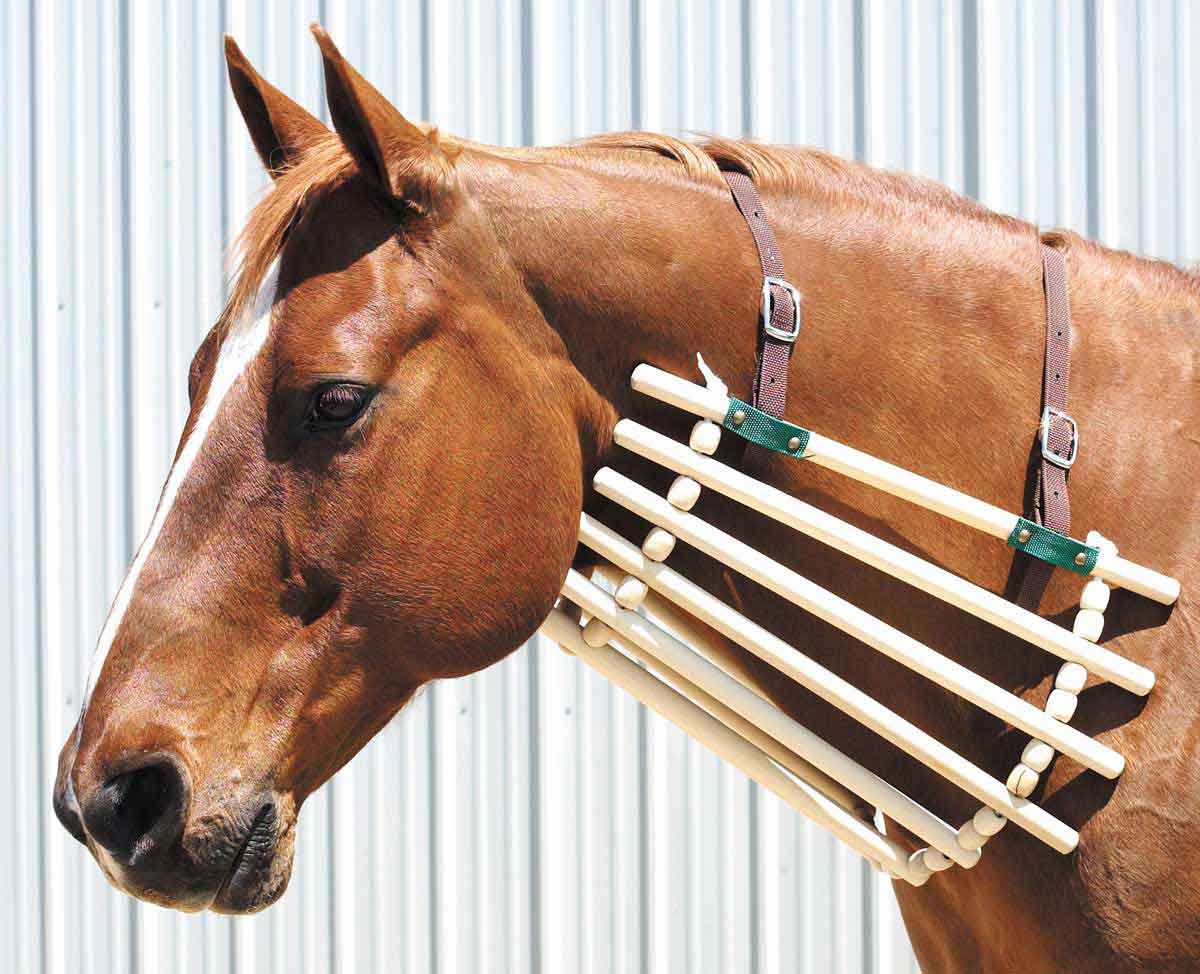
Cradle (courtesy: valleyvet.com)
Cradles: A cradle is a device consisting of 10 or 12 pieces of wood strung on two pieces of rope. A short piece of wood bored longitudinally is fitted in between long pieces. The long pieces are bored longitudinally at either end and a rope is strung through all of the pieces. Then it is put around the neck of the animal and tied along the crest. It is helpful when the animal must be prevented from getting its head to an injured or bandaged fore or hind limb or when medicine is applied to the body. It is also helpful in restraining a milking female when she wants to suck her own mild. Cradles allow very little vertical or lateral flexion of the head if properly applied.
Cattle Crush (courtesy: cashels.net)
Crushes: A crush (trevis) is a long, narrow alleyway for restraining animals in which animal's head is held in poles and the whole animal is firmly confined. It is especially useful for controlling large animals for operations such as dehorning, docking, and shoeing. Different types of crushes are used. These usually consist of four posts driven well into the ground and cemented there with two or more cross pieces at each side and end. Those at the end and/or the front are removable.
Ropes: Ropes are essential for restraining farm animals. Cotton rope is preferable because it is strong, safe and easy to use when making knots. Rough, hard ropes like coir should not be used since it can cause abrasions to the animals. Two sets of rope should always be kept ready: 
i. one about 2.5 - 3. cm thick and about 8 m long for sue in casting or securing large animals, and
ii. Two or three pieces, 1 - 1.5 cm thick and about 2 m long for securing small animals and the feet or horns of large animals. One or two lassos and rope halters should also be kept ready for any emergencies.

Restraining animals: Devices - 1

Halters: Halters are one of the simplest controlling devices for horses, cattle and buffalo. To make a halter, lay about 3 m of rope on the floor. At about 1 , from the left hand end, untwist the strands sufficiently to enable the right hand end to be passed through it to make a loop of about 2.5 cm in diameter. Lay the rope down as before. Close to the loop, untwist some strands again on the right hand side, and pass the left end through it. Pull up tight and bind the splice thus made with a few turns of string. To form a poll-piece, untwist the strands of the right hand length, about 25 cm from the loof already made, and pass the left hand end through it.
Make an overhand knot to fix. Bind on either side with string. Now pass the long right hand end through the spliced loop first made. This forms the nose-band. The halter is now complete. The knot in the poll-piece can be adjusted to fit the head of different animals.
To halter a horse, first slip the rope or shank of the halter around its neck by holding the forelock or resting the right hand on the neck just behind the ears. Then slip it over the horse's ears. The halter should be prevented from becoming too tight by putting a hitch or cinch in the shank as it leaves the nose-band. Placing the halter on the animals correctly should be practised until it becomes second nature. An incorrectly placed halter may be too loose to hold the horse, or may irritate it to the point where it becomes unmanageable.
Head Collars: Effective devices for controlling animals, head collars are used mostly with horses, but may also be used with cattle and buffalo. The head collar consists of a poll-piece, two cheek pieces, a nose band, a throat-piece, and a jowl-piece. Today, nylon head collars are increasingly being used because they are cheap, easy to clean, and durable.
A head collar is a very effective means for securing a horse in a stable or stall. A neck strap or neck rope is often used in the stable, but whether it is a halter or a neck tie, the shank in each case is put through a ring or hole in the manger, with the end attached to a metal or wooden "sinker" to prevent the horse from putting his foot on the head rope, yet allowing the maximum length of movement.
Fig 1 (Click to enlarge) - Courtesy: ryancoaxum.com
Horses may be tied to the rings that are often found in stalls or on the heel post. When tying a horse in a stable, it is best to use a knot that can be released quickly. A method of tying such knot is shown in Fig 1. The knot is made by doubling the head rope or the shank of the halter with one short end. This doubled piece of rope is put under the ring, and then another loop in the long end nearest the horse is inserted through the double end. The short end is pulled tight. A second loop is made in the short end, and this is put through the firsst loop and tightened by a pull on the long end. A quick tug on the short end releases the horse.
Twitches - Courtesy: fao.org
Twitches: A twitch is a tightening device used to restrain an animal. The different types of twitches are the stick twitch, halter twitch, loop twitch, and leg twitch. Twitches should be applied immediately before the necessary restraint is used. Since the device inflicts pain, repeated use should be avoided.
a. Stick Twitches:The stick twitch consists of a piece of stout wood about 1 m long with a 1.5 cm hole about three cm from the end. A piece of rope is inserted through this hole. While applying a twitch, the animal should be haltered and backed into a corner of the stable yard. Take the twitch stick under the right arm and stand on the near side opposite the left shoulder. Put the thumb and last three fingers of left hand trough the loop of the twitch, but leave the index finger out to prevent the loop slipping over wrist. Take the animal in confidence and get a good hold of the upper lip, leaving the nostrils free. With the right hand, rapidly twist up the stick. Take as tight a hold as necessary, but do not be unduly severe. The twitch helps restrain the animal by causing a harmless pressure upon a sensitive area of the upper lip. It also diverts the animal's attention from the part being manipulated and affords a strong hold upon the head of animal. If it is not possible t apply a twitch on the upper lip, then the lower lip or an ear may be used.
b. Loop Twitches: The loop twitch consists of a pliable rope with a running noose on one end. The noose is passed over the poll, into the mouth, and pulled tight. It should be used very carefully since it is liable to cut the commissures of the lips.
c. Leg Twitches: The leg twitch is an ordinary tourniquet applied about 10 cm above the knee or hock to immobilize the leg.

Continue... (Read about more restraining devices as gags, bull rings, muzzles, cradles, crushes and ropes in next post)

Transporting livestock by train and vehicle

Transport facilities for livestock are grossly inadequate in Pakistan. The stock owner has to use one of five ways to transport: by ship, train, plane, vehicle, or hoof. Transport by plane or ship, of course, isi usually reserved for costly race horses, zoo animals, and imported pure bred exotic cattle, etc. For long distances, rail transport, affords a savings on maintenance and handling charges, tolls, and other incidental expenses. Also, weight loss and death, potential consequences of transport by foot, can be avoided.
If rail transport is chosen, the wagons which are to carry livestock should always have a roof, provide for free passage of air, and have battened or non-slippery floors. In Pakistan wagons used for goods transport are generally used for transport of animals too. In such a wagon a 10 - 15 cm thick layer of sand should be spread on the floor. This prevents the animals from slipping, soaks up urine and makes lying down comfortable. The side doors should be left open for ventilation. Partitions of suitable size should be made using wooden poles to keep the animals on their feet while the train is moving.
Sheep should be packed in a wagon closely enough to prevent them from being thrown about during transit. Animals should be so grouped that those of approximately the same size and condition are loaded together. Horned cattle should be secured by the horns to the side of the wagon. They should stand head to tail so that alternate animals face the opposite directions.
It is necessary to carry the local feed and utensils for feeding, watering, and milking of animals during the journey. Two experienced attendants who can perform these tasks should accompany the wagon or truck load. Simple medicines for diarrhoea, bloat, fever, and injury should also be carried.
In the winter, the stock should be watered every 12 hours, once in the morning and once in the evening. In the summer, watering frequency should be at least three times a day. When a journey is of more than three days, off-loading for feed and rest is essential to maintain the health and well-being of animals.
Transport of livestock by vehicle has many advantages. It is very convenient to load the animals at the farm and directly transport them to their destination. Thus, the problems of repeated handling and associated disturbances, such as weight loss, can be avoided. On the other hand, if the journey is long and the roads unsurfaced, the cost of transport per Km is somewhat greater than it is by rail, and an extra strain is placed on the animals. Nevertheless, the advantages of vehicle transport outweigh the truck can then be taken to an earthen mound or any other raised geoplogical feature of convenient height and the animals loaded from the mound.
The precautions to be followed while transporting livestock by road are the same as for rail transport. An ordinary goods truck can take four to five cattle and buffaloes, or 20-25 small animals depending on their age and condition.
If goats are being transported in a vehicle, they should not be allowed too much space, otherwise they will be knocked against the sides as the vehicle moves. If only a few are to be transported, spare space can be filled with bales of straw. These must be firmly tied in place and should not provide the goats with any climbable surfaces or ledges. The ideal floor is a rubber mat covered with a thin layer of straw. Horned and dehorned goats should not be carried together in the same compartment. Goats should never be transported in a vehicle without a division between them and the driver.

Transporting animals: Sheep and Cattle

It is much easier to move a group of sheep than to try to separate one or a few from a flock. It is sometimes more efficient to sort (draft or cut a small group from a large flock using a gate. A well trained dog or another person is essential. It is often easier to take the whole group to the yards even when just a few are needed.
There is a high risk of smothering when a large group of sheep is run through a narrow gap, such as a gate in a rotational grazing system. The risk is reduced by adopting the following measures.
  1. Move the group uphill where possible
  2. Place a person immediately before the gap to cut off the flow
  3. Be particularly careful when a downhill movement leads to a stream crossing, culvert, gate, or other narrow area
  4. Stresses such as the presence of dogs and noise should be eliminated if possible to let the sheep look ahead to see where they are going. When there is too much stress, sheep mill around climb on each other's backs.
Sheep can be driven easily by dogs or people. Sheep that are kept in restricted spaces like fields learn to respond to dogs by forming a group. Feral sheep, on the other hand scatter when attempts are made to muster them with dogs. Once domestic sheep are in a group, they try to maintain a certain distance (flight distance) between themselves and the dog and so move away on the dog's approach. Single sheep also maintain a flight distance. Whey they cannot escape, they are likely to turn and face the dog or run past it to escape from confinement.
When driving sheep along public roads, have one person at the front to warn oncoming traffic and control the rate of movement and a more experienced person behind to move them forward. Sheep are "followers" animals, and will therefore naturally follow other sheep. They will also follow people who feed them regularly.
For cattle and buffaloes, as well as sheep, driving is the most economical way to move the animals, at least for short distances. It is essential that an adequate supply of food and water be available at suitable points along the route. All farm stock should be kept to a a well defined track because,
  1. Facilities for feeding and watering will often be available, 
  2. Wandering animals may spread diseases in the region through which they pass and can be properly checked by authorities on well defined roads.
Animals lose body weight while moving, THis loss can be minimized by proper scheduling of feeding and watering. Indigenous cattle are well served if ad libitum water supply points are locaated about 20 Km apart. Mutton sheep going to market should get water at intervals of about 10 Km, otherwise they will lose a large amount of body weight.
Cattle, including buffaloes, can be driven easily for about 30 - 35 Km a day, and sheep for half that distance. In summer, driving during the hottest part of day should be avoided. Whenever possible, animals should be driven on soft ground and not on hard roads.

Handling animals: Cattle

Skills and risk of injury: Good cattle handling is a skill which gets a job done safely, humanely, and quickly. Most cattle handling can be done with out physical exertion. It is best done with ingenuity and patience - not by force. By understanding the behaviour of cattle, actions can be predicted and thus directed to give the required response.
Cattle can cause injury to handlers in a variety of ways. At up to 800 Kg as an adult, a bull's weight is sufficient to knock down, trample, or crush a against wall or fence, either intentionally or accidentally. Bruised or broken toes may result from trampling by cattle unless protective foot wear is worn. Cattle and buffaloes use their heads to attack and to defend themselves. If horned, they can inflict severe damage when they attack with the head. A quick thrust sideways or forward can be fatal. They can butt with with great force and inflict injury even when polled or dehorned. Dairy bulls are particularly dangerous. Cattle/buffaloes usually kick with one hind leg at a time in a forward, outward, or backward movement, and so can stricke someone standing at their shoulder. Cows are particularly protective in the first day or two after calving and may attack anyone approaching their calves. Tail switching can cause injury to unprotected eyes if they are struck by the long hairs at the end of the tail.
Welfare: The welfare of animals is very important. It is our obligation to maintain their well-being. The whole handling procedure is easier when animals are relaxed. People with dairy farm experience generally accept that dairy cows are easier to handle when they are comfortable, that is, when they are clean, dry, and away from drafts.
Animals should be kept calm so that they move and stand quietly. Cattle should be allowed to settle down for 20 minutes or so after yarding. Control of arousal is fundamental in controlling the movement of animals. Handling, by its very nature, stimulates animals and raises their excitement level. Humped cattle have a reputation for being more difficult to handle in yards. It should be kept in mind that an animal's response to a stimulus depends not only on the type and intensity of the stimulus but also on the unique temperament of the animal.
Social Behaviour: Cattle and buffaloes are social animals, forming attachments and living naturally in groups. When a group is being formed or added to, there are usually conflicts among animals which are expressed by fighting, withdrawing, appeasing, etc. In this way two animals sort out which one has priority of access to something desirable like a patck of grass or a good place to lie down. This establishes a social herarchy which works for the befit of the herd. The struggle for dominance is especially noticeable in the case of cattle. When a social heirarchy is set up in a herd of cattle, it usually lasts for a long time.
When an animal is taken out of the group for more than a day, there is usually considerable antagonism shown towards this animals from the others when it returns. This can result in a drop in milk production in cows or physical damage among bulls. The animal should, therefore, be returned as soon as possible. If the animal has been away for more than a day, it is better to return it when the other animals in the group are engaged in some activity and too distracted to get involved in a fight. Fighting among cattle, particularly bulls, occurs when familiar and unfamiliar animals are mixed together in a group. The increased muscle activity results in elevaated pH of carcasses and dark, firm, dry meat.
Psychological behaviour: Early experiences can have a lasting impact on cattle and buffaloes, so it is especially important to exercise care and caution when handling an animal for the first time. One bad handling experience may be remembered by the animal for as long as three years. If cattle are handled gently from youth, they will be much easier to handle later, for example, when being loaded into a vehicle for transportation. If an animal has been handled badly when driven into yard, for example, it will be much more difficult to get it back into that area again. A handling system must be well established from the outset and made to work the first time.
From an early age, animals should be trained to accept and expect a daily routine. Cattle readily learn to accept routine, and routine makes dairy milking and handling much easier and productive. Animals even become so used to routine that small changes in their environment, such as a change of milker, can create excitement and result in a pronounced drop in productivity.
Handler characteristics: The attitude of the handler is very important. Impatient handling may cause injury and affect production dairy cows. A confident milker usually obtains higher yields. It is commonly believed that animals can detect a handler's lack of confidence. Handlers who are unsure of themselves certainly do not have good control over animals and so fail to get the desired responses from them. A new handler should therefore learn proper techniques from the start and keep practising them regularly.
Handling animals with minimum disturbance also increases the opportunity for heat detection the dairy herd. The animals' response to the stimulation of handling may point to certain conditions such as hypomagnesaemia or lameness.

Approaching animals for handling and restraining

General Precautions:
  1. When approaching an animal in a shed, stall, or paddock, always speak to it before touching it.
  2. Approach the anoimal from the left side and handle from the head or near the head (beware of the horns of cattle and buffalo).
  3. It is not advisable to carry a stick, but if one is needed it should be kept out of sight of the animal.
  4. Get some information about the animal from its attendant or owner, e.g. whether the animal is calm or aggressive.
  5. Treat strange animals with suspicion, but try not to let the animal know that you are afraid of it.
  6. The animal should wear a head collar or a halter. If required, use two ropes on the head collar and tie one to each pillar ring. (Two ropes are especially needed when working with stallions or bulls).
  7. Never handle the hind quarters or hind legs without having the animal's head held and a foreleg lifted or restrained.
  8. Take hold of the forelock (in the horse), ear, or nose until a halter has been put on. Do not grasp the nose too tightly, otherwise breathing may be obstructed.
  9. It is important never to make a sudden snatch at the animal's head collar. This alarms the animal and may make it suspcious on future occasions. 
  10. Keep in mind that some animals kick backwards, some forwards, and other laterally with their hind legs. some cattle can kick all three ways.
  11. Bulls, especially over a year old, are often treacherous and should be properly secured before being approached by a stranger. They are usually rung before they are one year old. It is wise not to trust a bull.
  12. When haltering horned animals, it is best to slip the poll-piece of the halter over the horns and ears before adjusting the loop around the nose, so that the animal cannot take the halter off and break loose.

Handling and restraining of farm animals

Handling, controlling, restraining, transporting, and casting farm animals sometimes causes them distress even when they are being well managed. Three principles should be kept in mind when conducting these procedures to avoid harming the animals or affecting their productivity.
- The stock man should try to minimize any stress experienced by the animals or the workers handling them.
- These procedures should be carried out in such a manner that the animal are not injured.
- These procedures should be carried out in such a way that the workers are not injured.
In order to meet these objectives, the stock man should ensure before starting that proper equipment is available for the procedure and that the equipment is clean and in good working order. He should know how to use the equipment properly, efficiently and quietly. People assisting a procedure should also know the procedure and feel comfortable while performing it. Fear is perhaps the most dangerous emotion when working with livestock, since a frightened person seldom considers the consequences of his actions. His fear may also be communicated to the animals and upset them, thus making handling more difficult.