Precautions before casting:
- Fast an animal for up to 12 hours before casting. If the animal has a full stomach, it may rupture during casting.
- There should be sufficient labor available to complete the manoeuvre in the shortest time with the least distress to the animal. It is necessary to have a reliable person at the animal's head in order to control it. Depending upon the size of the animal that must be cast, either two or three persons are needed to pull on the rope.
- The site for casting should be chosen carefully. The best choice is a well=grassed field where there is sufficient space and no objects which could cause injury. In bad weather a barn is suitable. There should be plenty of clean straw put down to make the animal's fall as comfortable as possible.
- A strong webbing halter or head collar must be used. There must not be a bit in the horse's mouth and any twitch that has been used in adjusting ropes must be removed.
- Any operations on the feet necessitate the removal of shoes. This is particularly necessary if hobbles are to be used in casting.
Casting Cattle and Buffaloes:
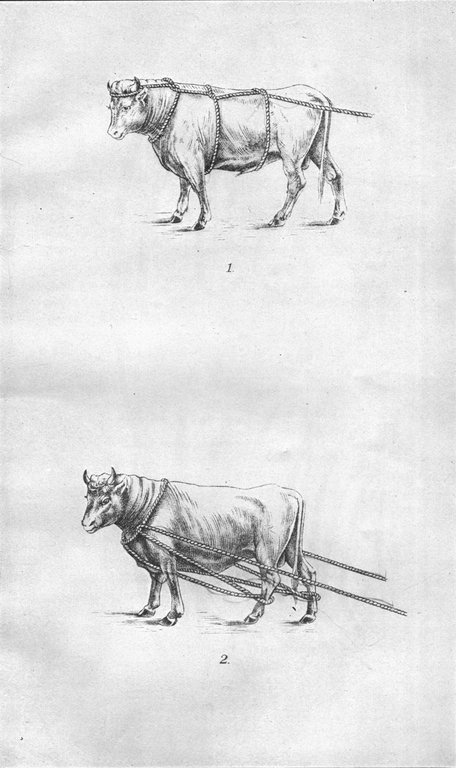 |
| Methods of casting animals (Courtesy: geutenberg.org) |
Cattle and buffaloes are cast for a variety of reasons: surgical operations, trimming of feet, and better control at a difficult calving. The most common and efficient method of cassting cattle and buffaloes is Reuff's method.
Reuff's method of casting cattle and buffaloes minimized the chances of injuring either the animal or people attending it. A running noose is made at one end of a 10 m long rope and passed around the base of the horns. In the case of polled animals, the noose can be placed around the neck. A half hitch is made around the neck, the second around the heart girth, and passed back and looped around the animal just behind the hip bones. A steady pull on the free end will cause the animal to collapse slowly. It is advisable to cast the animal on soft grass or a bed of hay or straw.
An alternative method is shown in figure, in which middle of the rope is placed over the neck and the ends passed between the front legs. They cross under the brisket, are passed upward and crossed over the back and then downwards past the flanks and between the hind legs. Traction on the free ends will then cause the animal to collapse. The ropes must cross under the brisket (Not on the throat), or the animal will not go down.
One great advantage of the latter method is that, because there are no knots involved, it is easier to remove the rope when you are finished with the animal. With Reuff's method, the rope tends to stay in a better position. This is an advantage when casting wild or excited cattle because the rope can be put on in the crush. The animal is then let out of the crush and the process of casting can begin.
Casting is not recommended for pregnant animals because of the possibility of abortion. It can also result in bloat, pneumonia, or displacement of the abomasum.
